Category: This Week in Watch History

Iconic watches and the milestones that shaped watchmaking, revisited week by week.

  • Christopher Ward, Hamilton and Omega, Three Different Ideas of a Reveal

    FROM THE ARCHIVE

    Christopher Ward, Hamilton and Omega, Three Different Ideas of a Reveal

    Across three late Augusts, the same week that a small brand chose theatre, a mid-priced house chose Hollywood, and a giant chose a catalogue.

    A brand’s own channel is a record it keeps of itself, whether it means to or not. Every upload is a decision about what mattered enough to film that week, and the titles alone, thin evidence as any title is, tell us where each maker wanted the attention to fall. Line up three of them from the same late-August window and you get three answers to the same question: what is worth showing.

    Omega uploaded a Seamaster Aqua Terra 150M Gents’ Collection film on August 25, 2017. The framing is plain and unembarrassed about it, a collection and its named model, aimed squarely at people already deciding between references. That confidence is its own kind of statement: a house this size does not need a hook, only a shelf.

    Hamilton took the opposite route on August 28, 2020, with a behind the scenes piece tying the Khaki BelowZero to Christopher Nolan’s TENET. The watch shares the billing with a film, which is exactly the trade Hamilton has long understood better than almost anyone, borrowing a story rather than telling one from scratch.

    Christopher Ward, the youngest and smallest of the three, called its August 27, 2021 upload a “Full Reveal” of the C60 Anthropocene GMT. The word reveal does a lot of work there, the language of an event, and it suits a brand still building the ceremony that Omega can take for granted.

    Set side by side, the three reads less like coincidence and more like a map of position. Omega points at a model and trusts the name, Hamilton points at a movie and borrows the glow, and Christopher Ward points at the act of showing itself. Same week, three different bets on how a new watch earns a look.

    Uploaded this week, August 24 to 30, in years past

    Christopher Ward · August 27, 2021 · via YouTube

    C60 Anthropocene GMT Full Reveal | Christopher Ward

    ▶ Watch on YouTube

    Hamilton · August 28, 2020 · via YouTube

    Behind the scenes TENET and the Hamilton Khaki Belowzero I Hamilton Watch

    ▶ Watch on YouTube

    OMEGA · August 25, 2017 · via YouTube

    Seamaster Aqua Terra 150M Gents’ Collection | OMEGA

    ▶ Watch on YouTube

    Why this watch, on this wrist?

    © Spot.Watch · This Week in Watch History

  • Patek Philippe Nautilus Reference 3700/1A: The Steel Watch That Changed Luxury in 1976

    Patek Philippe Nautilus Reference 3700/1A: The Steel Watch That Changed Luxury in 1976

    THIS WEEK IN WATCH HISTORY

    Patek Philippe Nautilus Reference 3700/1A: The Steel Watch That Changed Luxury in 1976

    A porthole, a bracelet, and a price tag that defied convention.

    In the 1970s, the Swiss watch industry was living through its worst nightmare. Cheap, accurate quartz movements from Japan were rewriting the rules, and the old houses of Geneva faced a question they had never had to answer: why would anyone pay for a mechanical watch made by hand when a battery kept better time for a fraction of the cost? Some firms folded. Others fled downmarket. A few decided the only way forward was to make the mechanical watch feel like an object worth wanting for reasons that had nothing to do with telling time.

    Into that anxious moment came the Patek Philippe Nautilus, reference 3700/1A, which debuted in 1976. It was luxury in an unexpected material, sold at a price that made buyers do a double take.

    The Watch

    The Nautilus was drawn by Gerald Genta, the same designer who had given Audemars Piguet its Royal Oak earlier in the decade. Genta famously claimed he sketched the design in minutes during the Basel fair. Whether or not the napkin is real, the design certainly is: a rounded octagonal bezel with two small “ears” flanking the case, joined by visible hinges that recall a ship’s porthole. The dial featured horizontal embossed grooves and a deep blue-black tone.

    Named after Captain Nemo’s submarine, the Nautilus was a bold move for Patek Philippe. What made the 3700/1A radical was not just its shape, but Patek’s ambition to sell steel at gold-watch prices. This was a large steel sports watch from one of the most conservative names in horology. Patek’s own advertising leaned into the paradox, presenting the Nautilus as a watch a discerning buyer would wear with a diving suit or a dinner jacket. The integrated bracelet flowed from the case without visible lugs, a detail that felt modern in 1976 and still defines the category today.

    Specifications

    Reference 3700/1A
    Year of debut 1976
    Designer Gerald Genta
    Case material Stainless steel
    Case diameter 42mm
    Case construction Two-part case with porthole-style bezel and lateral “ears”
    Dial Blue-black with horizontal embossed grooves
    Movement Self-winding caliber 28-255C, based on a Jaeger-LeCoultre ébauche and finished by Patek Philippe
    Bracelet Integrated steel

    Legacy

    The Nautilus did not sell in vast numbers at first. Steel Pateks were still an oddity in 1976, though not entirely unprecedented, and the world took time to understand what Genta had made. That patience has been richly rewarded. The Nautilus is now among the most sought after luxury sports watches in existence, and later references, particularly the discontinued 5711, have commanded waiting lists and secondary market premiums that dwarf their retail prices. Today, the original 3700/1A is a blue chip vintage piece, quietly commanding sums that would have astonished its first owners.

    Closing

    The Nautilus stands as proof that the watch industry survived quartz not by competing on accuracy but by refusing to. Patek Philippe bet that desire outlasts technology, and the porthole on your wrist is the receipt. The gamble of 1976 now looks prescient.

    Source: patek.com

    Why this watch, on this wrist?

    © Spot.Watch · This Week in Watch History

  • Rolex Oyster, 1926: The Birth of the Waterproof Wristwatch

    Rolex Oyster, 1926: The Birth of the Waterproof Wristwatch

    THIS WEEK IN WATCH HISTORY

    Rolex Oyster, 1926: The Birth of the Waterproof Wristwatch

    A century later, the case that made the wristwatch water resistant remains the foundation of Rolex’s Oyster-cased watches.

    A scene from the 1920s

    Period image from the 1920s, not the Oyster itself: Street clock in front of S Friedlander and Son, Inc, Seattle, ca 1922 (MOHAI 4361). Public domain, via Wikimedia Commons.

    The wristwatch faced a credibility crisis in the 1920s. It was fashionable, and the Great War had proven its convenience over the pocket watch, but it was still seen as fragile. Dust crept into movements. Moisture fogged dials and rusted mainsprings. A watch on the wrist lived a harder life than one in the pocket, exposed to rain, sweat, and the knocks of ordinary days, and the industry had not yet solved the problem of how to protect it.

    Then, in 1926, Rolex introduced the Oyster and offered its answer.

    A Fortress on the Wrist

    The genius of the Oyster was not a new complication or a prettier dial. It was the case. Rolex engineered a sealed construction with a screw-down bezel, case back, and, crucially, a patented screw-down crown, all threading tightly against a central case body. Sealed this way, the movement inside was protected from water, dust, and air, the three enemies that had quietly shortened the lives of generations of watches before it.

    The name itself carried the idea. An oyster keeps its contents locked behind a shell that water cannot penetrate, and the metaphor was irresistible. This was a wristwatch you could wear in the rain, at the beach, through the routines of daily life, without the same constant anxiety. It reframed what a watch could be: not a delicate ornament to be babied, but a tool that went where you went.

    Rolex’s Oyster-cased sports and everyday watches trace back to this moment. The Submariner, the Sea-Dweller, the Explorer, the entire Oyster Perpetual family, they are all descendants of that first sealed case. Rolex’s own newsroom describes the current Oyster Perpetual line as direct heirs to the original Oyster, the first waterproof wristwatch, on which the company has built its reputation since 1926.

    Specifications

    Model Rolex Oyster
    Introduced 1926
    Key Innovation Sealed, water-resistant case
    Case Construction Screw-down bezel, case back, and crown threaded against a central case body
    Significance Widely regarded as the first commercially successful waterproof wristwatch
    Legacy Line Direct ancestor of the entire Oyster Perpetual family

    How It Is Remembered

    The Oyster is one of the few watches whose importance is structural rather than stylistic. It did not simply add a feature; it removed a limitation that had held the entire wristwatch back. Water resistance turned the wrist into a viable home for a precision instrument, and it set the stage for the diving watches, field watches, and exploration tools that would define the twentieth century.

    Its reputation was cemented in 1927 when Mercedes Gleitze wore an Oyster around her neck during her “Vindication Swim” in the English Channel, giving Rolex a public demonstration of the watch’s durability that advertising alone could never have matched.

    Today the word Oyster is woven so deeply into Rolex identity that it appears in bracelet names, case designations, and on the dials of much of the brand’s catalog. What began as a solution to a problem became a permanent signature.

    A Hundred Years Sealed Shut

    A century after its 1926 debut, the Oyster’s influence is as pervasive as it is invisible. It is worth pausing on how rare it is for a single design decision to still be doing its job so long after introduction. The screw-down crown you tighten on a modern Rolex is the same conceptual gesture Rolex made in 1926. The Oyster did not just survive. It set a new standard by which every serious watch since has been measured.

    Source: newsroom.rolex.com

    Why this watch, on this wrist?

    © Spot.Watch · This Week in Watch History

  • Three Brands, Three Registers, One Week in Late August

    FROM THE ARCHIVE

    Three Brands, Three Registers, One Week in Late August

    A craft house, a film tie-in and a workhorse automatic, uploaded in three different Augusts with almost nothing in common but the calendar.

    A brand’s own channel is a kind of diary it keeps in public, and the titles it chooses to publish in a given week tell you where it wanted attention that year, even if the title alone cannot tell you what plays once you press start. Line up three uploads from this same stretch of late August and you get three companies talking past each other, each in the language it trusts most.

    Patek Philippe posted “Watchmaking Artistry” on August 20, 2021, and the word doing the work there is artistry. It is the register Patek returns to by default, the one that keeps the conversation on the hand and the bench rather than on any single reference or price.

    Hamilton went the other direction the year before, uploading “Official Watch of TENET” on August 17, 2020, and leaning on Christopher Nolan’s film rather than on a movement or a case. Hamilton has spent decades weaving itself into cinema, so a title that puts a blockbuster first and the watch second is the brand playing to an old strength at the moment the film was in the air.

    Timex sat furthest from both of them in 2019, publishing “Waterbury Automatic” on August 20. No borrowed glamour and no talk of craft, just a named model doing the plain thing product films do, which for a brand built on accessibility is exactly the point.

    What the three share is only the week itself. One reached past the object toward the abstraction of skill, one reached outward to Hollywood, and one simply named its watch and let that stand. Read together across three Augusts, they map the range of things a watch company can decide it is selling when it decides to press upload.

    Uploaded this week, August 17 to 23, in years past

    Patek Philippe · August 20, 2021 · via YouTube

    Watchmaking Artistry

    ▶ Watch on YouTube

    Hamilton · August 17, 2020 · via YouTube

    Official Watch of TENET I Hamilton Watch

    ▶ Watch on YouTube

    Timex · August 20, 2019 · via YouTube

    Waterbury Automatic | Timex

    ▶ Watch on YouTube

    Why this watch, on this wrist?

    © Spot.Watch · This Week in Watch History

  • In 2021: Centric Instruments Redefined the Solar Field Watch with the MKIII

    In 2021: Centric Instruments Redefined the Solar Field Watch with the MKIII

    In 2021: Centric Instruments Redefined the Solar Field Watch with the MKIII

    A masterclass in minimalist utility, combining classic military field aesthetics with a modern, light-powered engine.

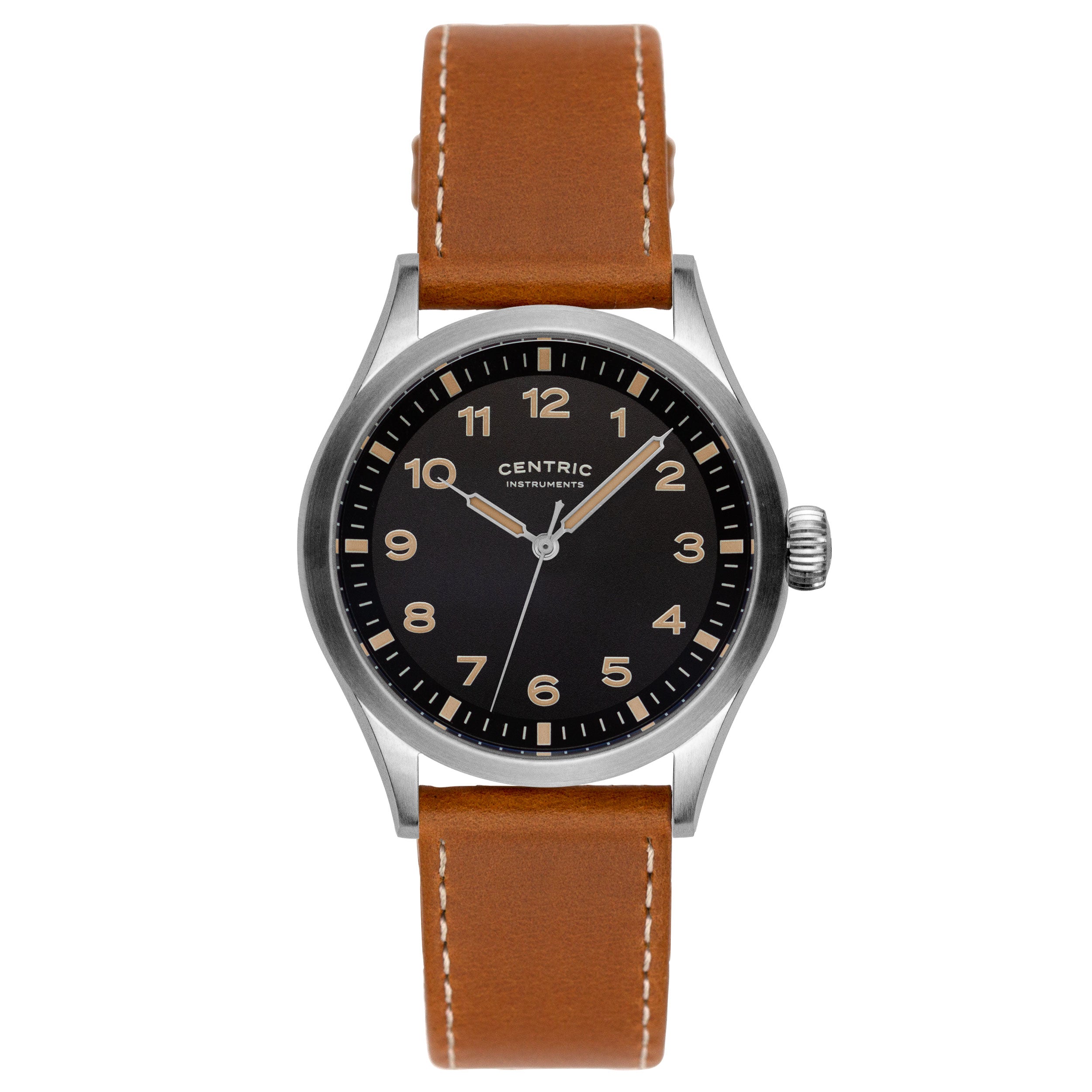
    The Centric Instruments MKIII 39 Vintage Black on a classic brown leather strap. Image source: Centric Instruments.

    The early 2020s marked a fascinating inflection point in the watch industry, one where microbrands like Centric Instruments began redefining what enthusiasts expected from a tool watch. While major Swiss houses leaned heavily into heritage reissues and integrated-bracelet sports watches, Centric’s MKIII 39 emerged as a quiet revolution: a solar-powered field watch that didn’t compromise on aesthetics or utility.

    Enter Centric Instruments. Founded with a mission to create the ultimate everyday tool watch, the brand bypassed the traditional choice between mechanical soul and quartz convenience. Instead, they focused on solar power. Against this backdrop, Centric Instruments launched the MKIII 39 in the summer of 2021, offering a masterclass in minimalist utility that resonated with a new generation of watch enthusiasts.


    The Release: Sunlight as a Complication

    Released during the summer of 2021, the MKIII 39 was designed to be worn outdoors, living on the very sunlight that powers it. Historically, solar-powered watches suffered from a distinct aesthetic flaw: their dials had to be semi-transparent to allow light to reach the solar cells underneath. This often resulted in cheap-looking, purplish, or plasticky dials.

    Centric Instruments solved this beautifully with the MKIII. By utilizing an advanced Seiko Epson solar movement, the watch required remarkably little light to stay charged, allowing the brand to use a deeply textured, matte “Vintage Black” dial. To the naked eye, the dial looks like a rich, solid instrument face, completely hiding the high-tech solar cell beneath.

    The design language of the MKIII is one of extreme restraint. The 39mm stainless steel case features clean, brushed surfaces and a slim 10.5mm profile that slips easily under a cuff. The dial is a masterclass in legibility, featuring bold Arabic numerals, a clean railroad minute track, and a discreet date window at 4 o’clock that doesn’t disrupt the symmetry of the hours.

    Specifications

    Here’s what made the MKIII 39 a standout in its category:

    Brand Centric Instruments
    Model MKIII 39 (Vintage Black)
    Release Year 2021
    Case Diameter 39mm
    Thickness 10.5mm
    Lug-to-Lug 46.5mm
    Case Material 316L Stainless Steel (Brushed finish)
    Movement Seiko Epson Solar Quartz (VS42A)
    Power Reserve Up to 6 months on a full charge (recharges with any light source)
    Crystal Curved Sapphire with anti-reflective coating
    Water Resistance 100 meters (10 ATM) with a screw-down crown
    Strap Premium Horween leather or heavy-duty nylon

    Legacy and Market Position

    Today, the Centric Instruments MKIII is remembered as a darling of the “Everyday Carry” (EDC) and microbrand communities. It proved that a solar watch could win over even the most discerning enthusiasts: those who typically prioritize mechanical movements but couldn’t ignore the MKIII’s blend of reliability, sustainability, and design integrity.

    On the secondary market, the MKIII has developed a cult following among collectors looking for a rugged, low-maintenance field watch that doesn’t sacrifice design integrity. It stands as a testament to the power of thoughtful, independent watch design.

    A Mid-Summer Reflection

    As we reflect on this day in 2021, the MKIII 39 reminds us of the poetic connection between horology and the environment. While mechanical watches capture our imagination with springs and gears, a solar-powered field watch like the MKIII connects us directly to the cosmos, converting the light of our nearest star into the steady, reliable ticking of time.

    © Spot.Watch · This Week in Watch History

  • In 1969: Zenith Released the El Primero Ref. A386

    The high-frequency legend that defined the automatic chronograph and powered the industry’s most iconic watches.

    In 1969, the watch world was locked in a fierce, clandestine arms race. The ultimate prize? The creation of the world’s first automatic chronograph movement. While rivals like Seiko and the Chronomatic Group (a joint effort by Heuer, Breitling, Hamilton-Büren, and Dubois-Dépraz, marketed as the ‘Chronomatic’ series) raced to adapt existing movements with chronograph modules, Zenith aimed for a far loftier peak. On June 27, 1969, Zenith officially unveiled the El Primero Ref. A386, forging an indelible legacy in watchmaking.

    The Ref. A386 was the physical manifestation of a dream Zenith began chasing in 1962. Instead of taking the easier route (slapping a chronograph module onto a base movement), Zenith’s watchmakers insisted on a fully integrated design. They opted for a column-wheel mechanism, a hallmark of precision.

    To truly stand out, they engineered the movement, codenamed Caliber 3019 PHC, to beat at a blistering 36,000 vibrations per hour (5 Hz). This high-frequency heartbeat, combined with its fully integrated, column-wheel design, allowed the watch to measure elapsed time with precision, including 1/10th of a second. Visually, the A386 was a mid-century masterpiece, breaking from the era’s monochromatic dials with its striking, overlapping tri-color layout in shades of silver, light grey, and dark grey, all housed in a beautifully proportioned 38mm stainless steel case.

    Specifications

    Brand Zenith
    Model El Primero Ref. A386
    Released June 27, 1969
    Case Size 38mm
    Case Material Stainless steel
    Movement El Primero Caliber 3019 PHC automatic chronograph
    Frequency 36,000 vph (5 Hz)
    Dial Tri-color overlapping sub-dials (silver, light grey, dark grey) with date at 4:30
    Crystal Acrylic
    Water Resistance Not specified
    Lug Width Not specified
    Power Reserve Not specified

    The El Primero’s engineering was so superior that its legacy extended far beyond Zenith’s own catalog. Its design set a benchmark for mechanical excellence that other brands simply could not match. Most famously, when Rolex sought to modernize the manual-wind Daytona in 1988, they turned to Zenith. For over a decade, a modified, slowed-down version of the El Primero movement powered the Rolex Daytona, bridging the gap until Rolex’s in-house Calibre 4130 debuted in 2000.

    Today, the original Ref. A386 is one of the most coveted vintage chronographs on the market. Collectors revere it not just for its gorgeous, instantly recognizable aesthetic, but for its historical significance as one of the most technically advanced automatic chronographs of its time.

    Looking back from 2026, where high-frequency chronographs and bold color palettes dominate the luxury landscape, the shadow of the A386 looms larger than ever. It was more than just a watch; it was a bold statement about the heights mechanical watchmaking could reach. In 1969, Zenith didn’t just release a timepiece, they set the heartbeat for the next half-century of horology.

    © Spot.Watch · This Week in Watch History

  • In 2015: Apple Opened Pre-Orders for the Apple Watch 1st Generation

    In 2015: Apple Opened Pre-Orders for the Apple Watch 1st Generation

    How Apple’s first wearable redefined the wristwatch, and the watch industry

    Nine years ago, on April 10, 2015, a single device challenged long-held notions of what a wristwatch could be.

    In 2015, the landscape of timekeeping was largely divided. On one side stood the venerated world of mechanical watches, celebrating intricate craftsmanship and heritage. On the other, the burgeoning but still niche realm of digital and “smart” watches, mostly catering to early adopters and fitness enthusiasts. The smartphone had already reshaped personal communication, but whether its functionality could successfully migrate to the wrist remained an open question. Could a tech company truly enter the deeply personal, often sentimental space of wristwear and succeed? Apple’s answer arrived in the spring of 2015, not with a quiet whisper, but with a bold reimagining of the wristwatch.

    31127224656?profile=RESIZE_710x

    On April 10, 2015, Apple opened pre-orders for its first-ever watch, a device that would soon become known to enthusiasts as the “Series 0” or 1st Generation Apple Watch. This wasn’t just another gadget; it was a deliberate redefinition of what a watch could be. From its sleek, rectangular form factor to its intuitive digital crown and Force Touch display, the Apple Watch was designed to be Apple’s “most personal device” yet. It promised a future where your wrist could track your health, deliver notifications, and even facilitate payments, all while maintaining a sleek, modern aesthetic.

    Apple Watch 1st Generation

    What truly set the original Apple Watch apart was its audacious market strategy and technological ambition. Apple didn’t just offer one watch; it presented a tiered ecosystem. There was the accessible aluminum “Sport” model, the more premium stainless steel version, and, most controversially, the opulent 18-karat gold “Edition,” priced between $10,000 and $17,000. This move signaled Apple’s intent to compete not just with Fitbit, but with Omega and Rolex, a bold gambit that captivated the tech world and sparked debate among traditional watchmakers.

    Specifications: The Dawn of a New Era

    Case Sizes 38mm and 42mm
    Materials Anodized aluminum (Sport), stainless steel, 18k yellow/rose gold (Edition)
    Display Force Touch Retina OLED
    Processor Apple S1 SiP (System in Package)
    Sensors Heart rate sensor, accelerometer, gyroscope, ambient light sensor
    Connectivity Bluetooth 4.0, Wi-Fi 802.11b/g/n
    Operating System watchOS 1
    Battery Life Approximately 18 hours
    Water Resistance IPX7 (splash resistant, not submersible)
    Starting Price $349 (Sport), $549 (steel), $10,000+ (Edition)

    Legacy: A Defining Moment

    The original Apple Watch, despite its initial limitations (like requiring an iPhone and a relatively short battery life of approximately 18 hours), was a resounding success. It swiftly became the world’s best-selling watch by volume within its first year, a title it has largely maintained ever since. Its release forced the traditional watch industry to confront the challenge of smart technology, leading to a flurry of “hybrid” smartwatches and a renewed focus on brand identity and mechanical artistry. While the 18k gold Edition proved to be a short-lived experiment, it underscored Apple’s ambition to redefine luxury on its own terms.

    Today, nine years on, the Apple Watch is ubiquitous. It has evolved into a sophisticated health and fitness device, offering features like ECG and fall detection, a powerful communication tool, and an indispensable companion for millions. The Series 0 is remembered as the pivotal moment a tech giant stepped onto the horological stage and fundamentally reshaped it, proving that a watch could be much more than just a time-telling instrument. It bridged tradition and innovation, proving that the wristwatch could evolve without losing its relevance.

     See a few of our other articles featuring the Apple Watch:

    © Spot.Watch · This Week in Watch History

  • In 1972: Hamilton Released the Pulsar P1 Time Computer

    In 1972: Hamilton Released the Pulsar P1 Time Computer

    Fifty-four years ago, the future of timekeeping arrived on the wrist. Encased in gold and radiating a futuristic red glow, it forever changed our perception of what a watch could be.

    The year 1972 was a fascinating crossroads for horology. While Swiss mechanical watchmaking still reigned supreme, whispers of the “quartz crisis” were growing louder. Seiko had launched its Astron in 1969, proving quartz accuracy was viable, but the notion of a watch without hands, without a ticking escapement, was still largely confined to science fiction. Amid this tension between tradition and innovation, Hamilton’s Pulsar division unveiled a device that would redefine the very concept of a wristwatch. On April 4, 1972, a watch emerged from the American watch brand Hamilton (under its Pulsar brand) that didn’t just hint at the future; it presented a bold vision of the future, packaged as a luxury item.

    31127474263?profile=RESIZE_584x
    A Pulsar P3 for sale on eBay

    The Dawn of Digital Luxury

    Dubbed the Pulsar P1 Time Computer, this groundbreaking device wasn’t merely the world’s first electronic digital wristwatch to go on sale to the public; it was a bold statement. Hamilton chose to introduce this revolutionary technology not as a cheap gadget, but as an exclusive, high-end product. Housed in an imposing 18k gold case, the P1 retailed for an astounding $2,100 USD. To put that into perspective, it was more expensive than many top-of-the-line Rolex models of the era, such as the Rolex Day-Date, which retailed for around $1,200. This firmly established digital timekeeping as a luxury proposition from its inception.

    What made the P1 so captivating was its pure, unadulterated modernity. It lacked traditional hands, instead displaying the time on demand via a vibrant red LED (Light-Emitting Diode) seven-segment display. This wasn’t an always-on screen; wearers pressed a button to illuminate the time for a few seconds, a necessary feature to conserve the battery life of the then-nascent LED technology. This ephemeral glow felt like something straight out of a space-age movie, a secret language between man and machine. Setting the time was equally novel, requiring a tiny magnet stored ingeniously within the clasp, to adjust the hours and minutes. The P1 was more than a watch; it was a conversation piece, a status symbol, and a tangible glimpse of tomorrow.

    Specifications

    Case Material 18k gold
    Display Red LED seven-segment display, time-only
    Movement Proprietary electronic module developed by ElectroData (a division of Hamilton)
    Power Battery-powered; display activated on demand to conserve power
    Setting Mechanism Magnet stored in the clasp used to set hours and minutes
    Price at Launch $2,100 USD (1972), more expensive than many top Rolex models of the period

    A Legacy That Still Glows

    The Pulsar P1 Time Computer’s impact was immediate and enduring. Though its gold case and high price limited its mass appeal, the P1 proved that digital timekeeping could be both aspirational and accessible, paving the way for the Casios and Timexes that would democratize the technology in the years to come. The “Time Computer” moniker itself was prophetic, hinting at the smart devices that would eventually adorn our wrists. It set the template for every digital watch, calculator watch, and ultimately, every smartwatch that followed.

    Today, the Pulsar P1 is a highly sought-after collector’s item, an icon of technological innovation and audacious design. Its scarcity and historical significance ensure its place in horological lore. It’s remembered not just as the first, but as a bold declaration that a watch could be more than a mere time-telling instrument; it could be a computing device, a luxury statement, and a portal to the future.

    Fifty-four years after its debut, the DNA of the Pulsar P1 lives on in every Apple Watch, Galaxy Watch, and advanced wrist-worn computer. Its red LED glow may have been eclipsed by newer technologies, but its spirit of innovation (its blend of cutting-edge technology with luxurious presentation) continues to illuminate the path for modern horology. Though Hamilton initially launched the Pulsar brand, it was later sold to Seiko in 1978, marking the end of an era for the American pioneer of digital watches. The Pulsar P1 wasn’t just a watch; it was the grandfather of the wrist-worn revolution, still ticking (or rather, glowing) strong in our collective memory.

    © Spot.Watch · This Week in Watch History

  • In 1992: Patek Philippe Released the Ref. 3974R

    In 1992: Patek Philippe Released the Ref. 3974R

    This Week in Watch History

    In 1992: Patek Philippe Released the Ref. 3974R

    A masterclass in haute horlogerie, this pink gold grand complication remains a defining symbol of horological prestige at auction.


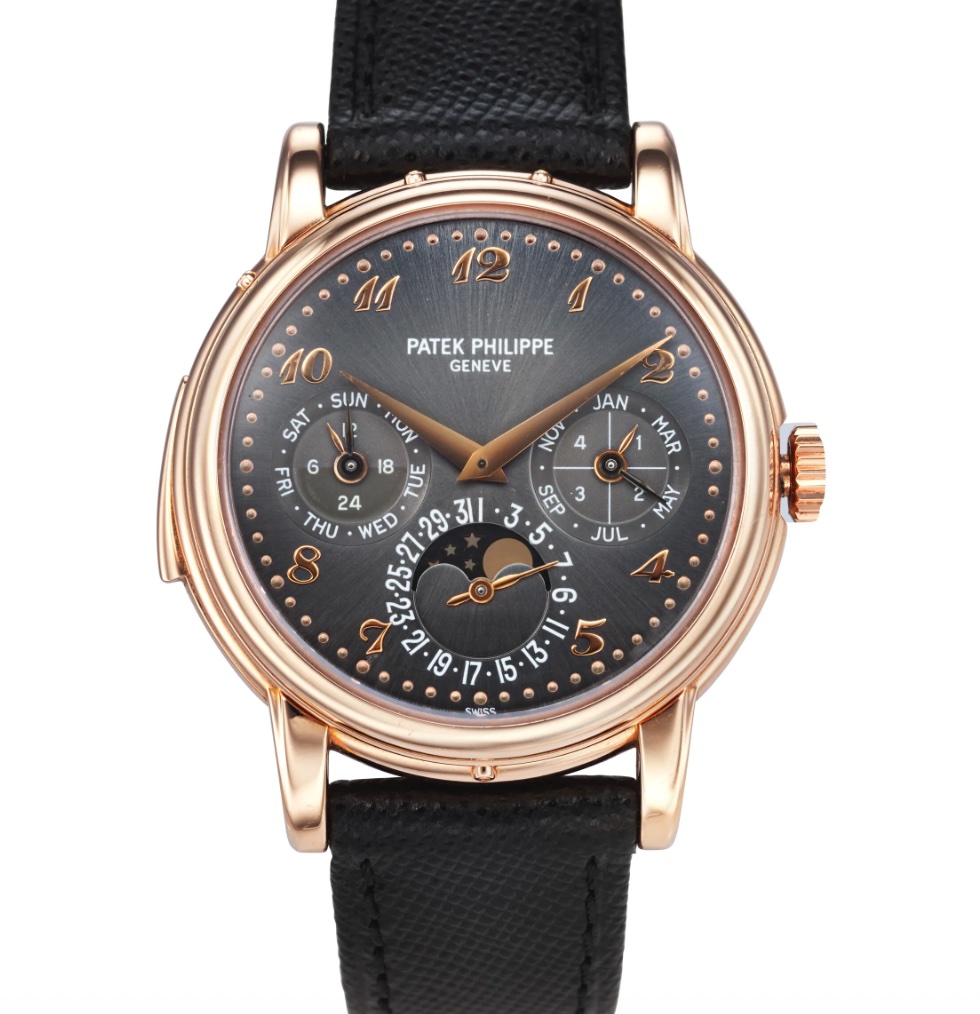
    Patek Philippe Ref. 3974R: pink gold grand complication, 1992

    Patek Philippe Ref. 3974R: pink gold grand complication, 1992. One of approximately 20 examples in this metal.

    In the early 1990s, the mechanical watchmaking renaissance was shifting from a quiet recovery into a triumphant roar. Following the devastation of the Quartz Crisis, Swiss maisons were no longer just trying to survive; they were eager to prove that traditional watchmaking could achieve heights no microchip ever could. At the absolute vanguard of this movement was Patek Philippe. After debuting the groundbreaking Reference 3974 in 1989 for its 150th anniversary, Patek Philippe spent the early 1990s delivering these mechanical marvels to elite collectors worldwide. Among these triumphs was the Reference 3974, a watch that would redefine grand complications and, in its pink gold iteration, become one of the most coveted timepieces of all time.

    The Reference 3974 was, at its debut, the most complicated wristwatch in the world. At the time, no other wristwatch had successfully integrated a self-winding minute repeater with a perpetual calendar, making the Ref. 3974 a landmark achievement in micro-engineering.

    But not all 3974s were created equal. While Patek Philippe produced fewer than 160 examples of the reference over its production run, only about 20 were cased in warm 18k pink gold (designated by the “R”). This specific piece, manufactured in 1992, represents one of the finest examples of bespoke watchmaking from the era. It features a specially ordered, believed to be one of a kind, slate-grey dial adorned with exquisite applied Breguet numerals.

    Its case, hand-sculpted by the legendary master case maker Jean-Pierre Hagmann, further elevates its monumental provenance. Hagmann was renowned for creating cases that allowed a minute repeater’s chimes to resonate with unparalleled clarity and warmth, and his work on this pink gold housing exemplified his mastery. Hagmann’s cases were celebrated for their acoustic perfection, a rarity in wristwatch repeaters.

    “No other wristwatch had successfully integrated a self-winding minute repeater with a perpetual calendar, making the Ref. 3974 a landmark achievement in micro-engineering.”

    Watch Specifications

    Patek Philippe Ref. 3974R

    Brand Patek Philippe
    Model Ref. 3974R Minute Repeating Perpetual Calendar
    Year 1992
    Case Material 18k pink gold (crafted by Jean-Pierre Hagmann)
    Dial Specially ordered slate-grey with applied pink gold Breguet numerals
    Movement Automatic
    Complications Minute repeater, perpetual calendar, moon phases, 24-hour indicator, leap year display, day/night indication
    Rarity One of approximately 20 pink gold examples; unique dial configuration

    Legacy

    Given its rarity and Hagmann’s unparalleled craftsmanship, it was no surprise when this Ref. 3974R took center stage at Christie’s “Important Watches: Stories in Time” auction in June 2025. Stepping into the spotlight as the undisputed top lot of the sale, this masterpiece commanded a staggering price of $1,197,000.

    In a market where trends can be fickle, this result was a powerful reminder of a fundamental truth: grand-complication Patek Philippes remain the ultimate gold standard of horological collecting. The combination of Hagmann’s legendary case construction, the rare pink gold metal, and the highly coveted slate-grey Breguet dial elevates this piece from a mere watch to a historic work of art.

    Looking back today, on June 9, 2026, as a new auction season begins in New York, the triumph of the Ref. 3974R resonates deeply. It stands as a monument to an era when Patek Philippe redefined what was possible in mechanical watchmaking. Decades after it left the workshop, the Ref. 3974R’s melody endures, a reminder that exceptional craftsmanship transcends time.


    spot.watch  ·  This Week in Watch History  ·  June 9, 2026