Category: Microbrands

  • Isotope Watches: A British Independent That Prefers New Ideas to Vintage Repeats

    Isotope Watches: A British Independent That Prefers New Ideas to Vintage Repeats

    MICROBRAND

    Isotope Watches: A British Independent That Prefers New Ideas to Vintage Repeats

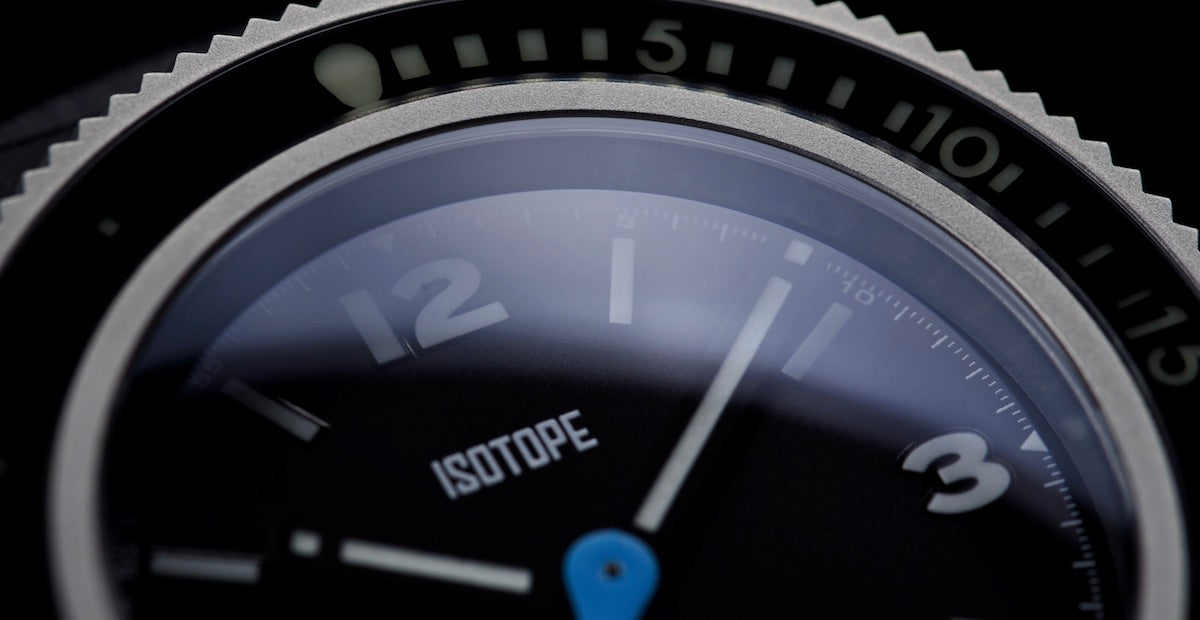
    Founded in Henfield by José and Joana Miranda, Isotope has built a clear identity around unconventional displays, teardrop motifs, and limited runs that rarely look like anything else in the microbrand lane.

    Isotope Watches — Isotope Watches: A British Independent That Prefers New Ideas to Vintage Repeats

    Image: source

    Many young watch brands begin by looking backward. Isotope started with a different premise: take something familiar and rearrange it into a new form. The name comes from the scientific term “isotope,” and that idea of variation within a known framework has shaped the brand since its launch in 2016.

    Isotope was founded by José and Joana Miranda, a Portuguese-English couple based in Henfield, England. According to Oracle Time’s profile of the brand, José came to the project as a collector who wanted a watch he could not find on the market, then worked with designer Vikenty Gryaznov to help define the look. That pairing matters, because Isotope did not enter the scene with a familiar field watch or another vintage diver. From the beginning, it aimed for a more distinctive visual language.

    What Makes It Notable

    The early statement piece was the Rider Jumping Hours, a watch that helped establish Isotope’s design identity. Its most recognizable feature was the repositioned jumping hour display at 6 o’clock, rather than the more common placement at 12. Around it sat the brand’s recurring teardrop form, part of what Isotope calls its Lacrima design language.

    That shape has become Isotope’s calling card. It appears across the collection in apertures, markers, and display elements, giving the catalog a coherence that many microbrands never quite achieve. Even when the complications change, the watches still read as Isotope.

    The brand has also shown a willingness to experiment with display formats beyond the usual microbrand formula. Reports from Oracle Time and coverage from Teddy Baldassarre have highlighted its use of rotating disc indications and more unusual dial treatments. Some specific technical claims around “world first” execution and certain dial materials should be treated cautiously unless confirmed by Isotope directly, but the broader point stands: this is a brand focused on original presentation rather than homage design.

    Signature

    A strong candidate for the definitive Isotope is the GMT 0°. Oracle Time highlighted it as a key expression of the brand’s style, and it is easy to see why. The teardrop motif is turned into the central visual architecture of the watch, shaping both the GMT display and the hour aperture, while a peripheral date keeps the dial balanced.

    The published specs commonly associated with the GMT 0° include a customized Swisstech automatic movement and about 40 hours of power reserve, with pricing around £740 at launch (unconfirmed). Reported edition sizes include 49 pieces per colorway, with some rarer variants produced in even smaller numbers (unconfirmed). As with most Isotope releases, exact availability and current pricing are best confirmed on the brand’s own site.

    At the more complicated end, the Chronograph Moonshot is one of Isotope’s more ambitious releases. Its chronograph display replaces familiar hand based registers with rotating disc style indications, giving the watch a very different look in use. Depending on the edition, pricing has been reported in the roughly $2,500 to $3,340 range (unconfirmed), and movement details should be checked against the official product listing for the specific reference.

    For a more accessible entry point, the HydriumX line brings the same house style to a colorful diver format. Oracle Time discussed editions such as the “Will Return” and Burnt Tangerine versions, noting limited production and sub-£500 pricing at the time. Isotope’s own pricing has also appeared higher for some versions, including figures in the mid-£500 range, so current retail should be verified before purchase.

    Where To Find Them

    The best place to track current releases is Isotope’s official website: isotopewatches.com

    Because the brand works in small batches and limited colorways, stock can change quickly. If a particular model is the reason you are visiting, it is worth checking the official site first rather than relying on older reviews or launch coverage.

    Isotope’s appeal is not just that it is independent. It is that it has chosen a harder route: building a recognizable design language of its own. In a corner of watchmaking crowded with familiar references, that still counts for a lot.

    Visit Isotope Watches →

    Sources: Oracle Time; Teddy Baldassarre; Isotope official website.

    Why this watch, on this wrist?

  • Marin Instruments makes one watch, and keeps sharpening it

    Marin Instruments makes one watch, and keeps sharpening it

    MICROBRAND

    Marin Instruments makes one watch, and keeps sharpening it

    A Santa Fe microbrand run by a working watchmaker, built on a black and white design language and one rule: form follows function.

    Marin Instruments is the work of Justin Walters, who started the brand in Santa Fe, New Mexico, during the pandemic lockdown. The route there was not a straight line. He went to art school for ceramics, got thrown out of his major class for refusing to make the required 104 small studies, switched to design, and took a BA in graphic design. That led to a few years drawing skateboard graphics and t-shirts for Girl Skateboards and Fourstar Clothing, including a board for Sean Malto.

    Watches arrived through his father’s broken Wittnauer, which he taught himself to take apart and put back together, breaking a fair number of others along the way. He went on to work at a watch startup in Kansas City, apprenticed under a friend who worked for Omega, then moved to Florida to work as a watchmaker for Honeywell, which does not make watches but does hire watchmakers to service very delicate equipment. He tells the whole story himself in Journal Entry 1.0.

    The name is less considered than it looks, and Walters is refreshingly candid about it. He took the word Marine, dropped the e, and stopped. He wanted something short and strong that would sit evenly on a dial, and five letters solved the symmetry problem. Only later did he learn that marin means “of the sea” in French.

    What makes it notable

    The brand’s stated position is that modern watchmaking has the priorities backwards. Its Our Story page argues that too many watches are designed without any thought for how design affects function, and sets out three principles instead: purpose, design, quality. In practice that means a primarily black and white palette, color used only where it improves legibility, and a stated philosophy of less but better. It is a tidy summary of what the watches actually look like, which is not always true of a brand manifesto.

    There is one honest tension worth naming. Our Story insists the brand is “not creating homages or tributes,” while Walters cheerfully says the Skin-Diver is a mix of his two favorite dive watches, a Rolex Submariner 16610 and a Seiko 7S26-0030, and that he was not trying to fundamentally change the dive watch at all. Both things can be true, and the combination is more interesting than either claim alone: not a copy of one reference, but two blended and then redrawn by someone whose training is in type and layout. Worn and Wound noticed exactly that, calling the dial “a graphic designer’s master class in proper leading, kerning, and tracking.”

    The press response has generally been warm. Hodinkee’s Cole Pennington described Marin as “a young brand that’s modernizing the classic ’60s skin diver,” and Time and Tide’s Vincent Deschamps summed it up as “a skin diver for the 21st century.” The brand collects those notices on its own reviews page.

    The Skin-Diver

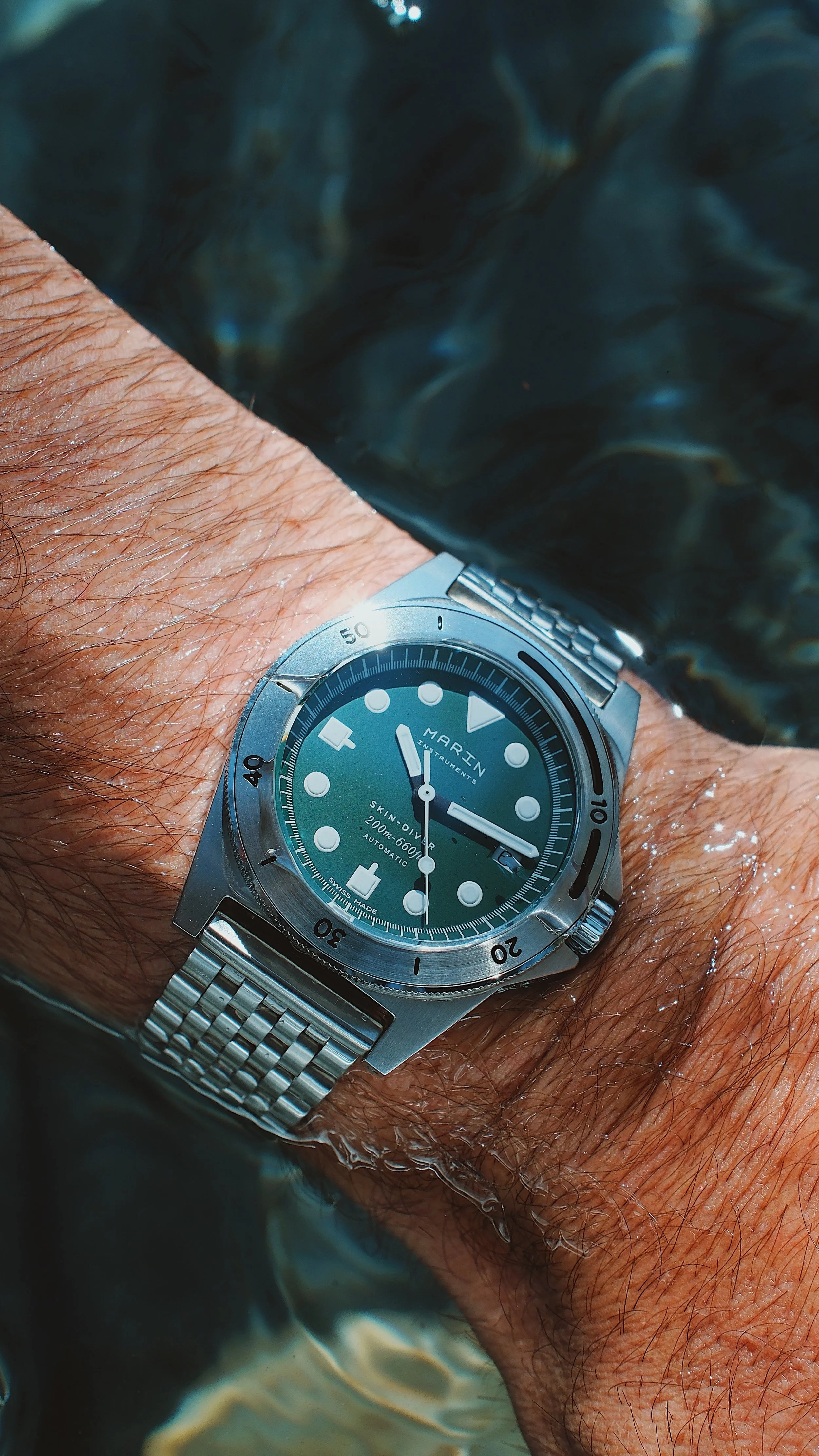
    The Skin-Diver was the first watch in the collection and it is still the only platform. Everything in the shop is a variation on one case: 39mm wide, 48mm lug to lug, 11.5mm thick, on 20mm straps, under a flat anti-reflective sapphire crystal, rated to 200m and running the Sellita SW200-1. There is no field watch, no GMT and no chronograph. One case, worked through different dials, bezels and finishes.

    CaseStainless steel, 39mm wide, 48mm lug to lug, 11.5mm thick, 20mm lugs
    CrystalFlat anti-reflective sapphire
    MovementSellita SW200-1 automatic
    Water resistance200m
    Bezel60 click unidirectional steel; fully lumed and PVD coated on the Standard
    Price$1,050 to $1,750 depending on variant
    Warranty5 years, covering case, strap, buckle, bezel, crystal, dial, hands and movement

    The bezel is the detail that carries the legibility argument furthest. On the Standard, Marin describes it as a fully lumed, 60 click, unidirectional stainless steel bezel that has been PVD coated, which means the whole timing scale glows rather than just a pip at twelve. The limited Steel Skin-Diver S and P go the other way, swapping in a circular grain polished steel bezel with black numerals for a sleeker look. Same 60 click action, a completely different watch on the wrist.

    The variants are where the range lives: the Standard, the Standard OS with an orange seconds hand, the polished Steel S and P, the Odyssey and Odyssey: Baja, the Taupe, the Alpine, and the Desert PVD. Several are strictly limited, the Alpine to 50 pieces. Pricing runs from $1,050 for the Standard up to $1,750 for the Desert PVD, with the Standard OS at $1,095, the Odyssey pair at $1,250, the Steel variants at $1,295 and both the Alpine and Taupe at $1,495.

    Where to find them

    Marin sells direct, with free shipping, and notes that VAT and duties are not included. One thing to know before you get attached to a particular dial: at the time of writing every watch in the shop is listed as sold out, with a notify option on each product page. The accessories are still there, including the 7 link bracelet with quick release fittings at $99 and the Marin rubber strap at $75. Small batches from a one-man operation mean availability moves, so the shop is the only reliable place to check.

    Marin Instruments is compelling because it understands that vintage-inspired is not an argument on its own. The stronger case, and the one the watches actually make, is that a good tool watch should be calm, readable and deliberate, and that a designer who also services movements for a living is unusually well placed to build one. On that front Marin is convincing. The harder problem now is making enough of them.

    Visit Marin Instruments →

    Why this watch, on this wrist?
  • Bausele, the Australian Watch Brand That Puts a Piece of Place in the Crown

    Bausele, the Australian Watch Brand That Puts a Piece of Place in the Crown

    MICROBRAND

    Bausele, the Australian Watch Brand That Puts a Piece of Place in the Crown

    With sand, earth, opal, or sea glass sealed inside the crown, Bausele turns a simple design detail into its calling card.

    Bausele: the Australian watch brand that puts a piece of place in the crown

    Image: source

    Origin

    Bausele was founded in Sydney in 2011 by Christophe Hoppé, who set out to build an Australian watch brand with a stronger link to Swiss watchmaking than most local labels. The name is a contraction of “Beyond Australian Elements.” From the start the formula was simple: Swiss movements and components, Australian design, and a brand identity rooted in place.

    In 2015, Bausele became the first Australian watch brand to exhibit at Baselworld, putting the young Sydney label in front of an international watch audience.

    What Makes It Notable

    Bausele’s defining idea is the crown. Many of its watches use a hollow, capsule-style crown holding a small piece of Australia, such as beach sand, red earth, opal, or sea glass, giving the wearer something tactile and specific rather than relying on color or case shape alone.

    That signature has carried into bespoke commissions for the Australian Defence Force, the Royal Australian Air Force centenary, the Sydney Opera House, and Harvard Business School. Even so, the brand has stayed close to its base, selling mostly direct through its own site rather than trying to look bigger than it is.

    Signature

    The Elemental line captures that idea in its most wearable form. The Elemental Coorong Mist pairs a 40mm stainless steel case (46mm lug to lug) with a Sellita SW200 automatic movement running at 28,800 vibrations per hour with roughly 38 hours of power reserve, a familiar Swiss caliber known for easy servicing.

    Sapphire crystal and 200 meters of water resistance round out a watch built for regular use, not just for the story sealed inside its crown.

    Pricing runs around A$1,200, or roughly US$750, with made to order lead times of 12 to 15 weeks; figures vary by model and exchange rate.

    Where to Find Them

    The current collection is available at Bausele’s official website, which is also the best place to confirm specifications, pricing, and delivery windows before ordering.

    Visit Bausele →

    Why this watch, on this wrist?

  • Why MONTA Chose Signal Yellow and Safety Orange for the Oceanking

    Why MONTA Chose Signal Yellow and Safety Orange for the Oceanking

    DROP

    Why MONTA Chose Signal Yellow and Safety Orange for the Oceanking

    In a June journal entry, MONTA frames dial color as an engineering decision, not a styling one.

    MONTA (Monta, LLC) Oceanking, Signal Yellow and Safety Orange limited editions

    Image: source

    Most brands introduce a new dial color like a restaurant’s daily special, here it is, enjoy. This June, MONTA took a different approach. Michael DiMartini documented the reasoning behind the choice, explaining why the next two Oceanking limited editions would use signal yellow and safety orange instead of other options.

    The reasoning draws from maritime language. DiMartini cites dive flags, surface marker buoys, rescue gear, and life vests as precedents. “These are not fashion colors,” he writes in MONTA’s journal entry. Yellow, he argues, remains visible in cloudy water, while orange stands out at the surface, where someone might need to spot you.

    The more revealing detail is MONTA’s self-assessment. Last summer’s Turquoise Oceanking, a hundred pieces, gets described as a straightforwardly aesthetic decision, and the brand sets it directly against this year’s logic. “This year we made a watch for the water, and summer came along anyway,” DiMartini writes, which is a neat way of admitting the two colors will also look excellent in July.

    Everything under the dial stays put. The black ceramic bezel common to the line carries over, as do the case, movement and bracelet. Each color is held to 50 pieces, with shipping expected in August.

    For anyone tracking Oceanking colorways, that willingness to grade its own past decision is worth more than the colors.

    Referenceunknown (not stated in source)
    Priceunknown (not stated in source)
    ReleasedEditorial published June 10, 2026; source states the two limited editions "ship in August", exact year not explicitly stated but contextually implied to be 2026 (unconfirmed).
    SpecsSource does not provide case size, material specifics, movement caliber, or water-resistance rating. It states only that the new colorways use "the same proven case, movement, and bracelet" as the standard black-dial Oceanking, paired with the "same black ceramic bezel that anchors every Oceanking." No numeric specs given in the material provided; product-page spec anchoring was not available in the supplied source set.

    Source: announcement

    Why this watch, on this wrist?

  • Oak & Oscar and the Humboldt GMT

    Oak & Oscar and the Humboldt GMT

    MICROBRAND

    Oak & Oscar and the Humboldt GMT

    Oak & Oscar has built a loyal following on wearability, finish, and small batch production. The Chicago brand’s Humboldt GMT distills that formula into a travel ready watch made for every day.

    Chase Fancher founded Oak & Oscar in Chicago in 2015 and launched with the time and date Burnham. From the start the brand has favored useful, well finished mechanical watches over novelty, and that clear identity has helped it stand out in a crowded microbrand field.

    What Makes It Notable

    Oak & Oscar is often associated with the GADA ideal, shorthand for “go anywhere, do anything”: versatile sports watches with clean styling, solid proportions, and enough refinement to move between casual and dressed up settings. Small production runs and direct sales let more of the budget go into visible quality, from case finishing to dial execution and strap hardware.

    The appeal is not radical design. It comes from Swiss automatic movements, balanced sizing, and the sense that each release has been edited rather than overworked. Enthusiasts tend to discuss the brand less for its marketing and more for how the finished product feels.

    Signature

    The Humboldt GMT is one of the clearest expressions of that style: a stainless steel travel watch with a second time zone, equally at home on a trip or in the daily rotation.

    Oak & Oscar lists a 39.5mm case with a 40mm bezel, a 12.5mm case height, 46.8mm lug to lug, 20mm lugs, 200 meters of water resistance, and a double domed sapphire crystal, with the 25 jewel Swiss Sellita SW330 automatic inside (source: Oak & Oscar, oakandoscar.com/products/the-humboldt-gmt). Those numbers put it squarely in the wearable middle ground the brand favors.

    It is listed at $1,975 on a Horween leather strap or $2,175 on the stainless steel bracelet, in white, navy, and black dial options, with current availability on the same product page.

    For current models, exact specifications, and availability, visit Oak & Oscar’s official site: oakandoscar.com

    Visit Oak & Oscar →

    Why this watch, on this wrist?

  • Santurce Collection Brings Puerto Rican Identity to the Modern Dive Watch

    Santurce Collection Brings Puerto Rican Identity to the Modern Dive Watch

    MICROBRAND

    Santurce Collection Brings Puerto Rican Identity to the Modern Dive Watch

    Founded in 2025 by a husband-and-wife team of collectors, this Puerto Rican microbrand backs its island identity with serious spec: twin 39mm Sellita divers, an artist-drawn caseback, and a GPHG nod in year one.

    The barracuda is a patient fish. It lurks in Puerto Rico’s warm shallows, silver and motionless, until it isn’t. Locals call it the picúa — and it is one of two Caribbean predators lending their names to the dive watches of Santurce Collection, a young microbrand out to put Puerto Rico on the horological map.

    The Joke That Became a Brand

    Santurce Collection is run by José and Anita Salas, a husband-and-wife team from the San Juan district that gives the brand its name. Both are lawyers, longtime collectors, and founders of Puerto Rico’s RedBar chapter. The name predates the company: when Anita asked for more closet space, José began selling watches from his own collection at friend prices, and local collectors took to calling any well-curated watch at a good price a “#SanturceCollection.”

    In 2025, the inside joke became a company with a mission: watches designed in Puerto Rico, with an identity of their own. The brand is rooted in place first, product second — and it shows.

    Two Divers, One Platform

    Santurce Collection Picúa dive watch

    Image: Time+Tide

    The brand’s fully custom line consists of two 39mm divers: El Tiburón (“the shark”) and the Picúa. They share a platform — a forged, heat-treated 316L steel case measuring 12.2mm thick and 46mm lug-to-lug, a 120-click bezel with DLC-coated steel insert, sapphire crystal with anti-reflective coating on both sides, 300 meters of water resistance, and Sellita’s SW200-B automatic, ordered without a phantom date position. Design happens in Puerto Rico, assembly in the USA. Each is priced at $949.

    The two wear their names differently. El Tiburón’s sandblasted matte case echoes the grey of a shark’s skin; the Picúa pairs linear brushing with a black sunburst dial, rectangular markers, and red accents straight out of the 1970s skin-diver playbook.

    The caliber choice tells you something about how the founders think. The SW200-B is unglamorous and everywhere, and that is precisely the argument for it. Parts exist. Watchmakers know it cold. A brand this young cannot promise it will be around in fifteen years, but it can pick a movement that will be serviceable whether or not it is.

    Flip either watch over and the cultural argument gets literal: the caseback carries “El Jíbaro Buzo,” an engraving that reimagines Puerto Rico’s traditional jíbaro figure as a diver — drawn by co-founder Anita herself.

    Recognition, Fast

    The spec-per-dollar story has already drawn notice beyond the enthusiast forums. El Tiburón has been selected as an official competitor at the 2026 Grand Prix d’Horlogerie de Genève, as Time+Tide reports — rare air for a brand in its first full year. The Picúa’s initial run sold out, with more stock expected; El Tiburón remains available in limited numbers. For hands-on impressions of both, see Ariel Adams’s review at aBlogtoWatch.

    Plenty of watches borrow a sense of place. Fewer are built by people who never had to look one up.

    Visit Santurce Collection →

    Why this watch, on this wrist?

  • Selten Watch Company

    Selten Watch Company

    MICROBRAND

    Selten Watch Company

    An independent microbrand using meteorite, bronze, and enamel to punch far above its price class.

    Selten Grand Feu Enamel — Spiral, Golden Fall

    Image: Selten

    Selten Watch Company makes more sense once you understand the name. “Selten” is German for “rare,” and rarity is the point. Instead of the usual microbrand path of sporty homages and familiar case shapes, Selten has built its identity around unusual dial work and craft led finishing.

    Origin

    Selten was founded in 2021 by Leonardo Tsai, who comes from a Hong Kong family of watch dial makers and left a finance career at JP Morgan to start the brand. It shows: this is a company that leads with the dial first, then builds the rest of the watch around it. Early releases leaned into materials still uncommon at this end of the market — meteorite dials, hand patinated bronze — living up to the slogan “A Rare Kind, Not a Stereotype.”

    What Makes It Notable

    The intent is to bring techniques and materials usually associated with far more expensive watches into a direct to consumer price bracket. In Mike Razak’s hands on review for aBlogtoWatch, he recalls collectors wearing Pateks and Journes assuming the debut Series 00 cost thousands rather than its $750 MSRP. Selten’s newer work goes further still, especially in enamel.

    Signature

    The standout is the Grand Feu Enamel series, the opener of Selten’s Métiers d’Art collection. Per aBlogtoWatch’s review, the 39mm stainless steel case is 10.9mm thick with a 45.5mm lug to lug, a lightly domed sapphire crystal, and 50 meters of water resistance — strong everyday dimensions for a watch that reads as dressy. Details like a polished concave bezel, a brushed mid case, and two spring bar positions to keep straps from rubbing show real thought.

    The dial is the main event. Each starts with a hand engraved pattern — 700 individually cut lines, not machine turned guilloché — finished in grand feu enamel, offered in spiral or radial patterns and five colorways: Rustique red, Sunbird blue, Prism violet, Moonstone light blue, and Golden Fall gold. Launch pricing was $1,899 for the radial dial and $2,199 for the spiral; made to order versions now run $2,599 and $2,899, with a bracelet at $80, or $150 with an extension clasp. That is a higher bracket than entry level microbrands, but well below the usual territory for hand worked enamel dials.

    Official Website

    Selten sells direct through its official website — the best place for the current catalog, availability, and specifications. For an independent third party look at the Grand Feu Enamel, see Mike Razak’s review at aBlogtoWatch.

    Visit Selten Watch Company →

    Why this watch, on this wrist?

  • Resco Instruments: Tool Watches With Real Service Roots

    Resco Instruments: Tool Watches With Real Service Roots

    MICROBRAND

    Resco Instruments: Tool Watches With Real Service Roots

    Founded by a retired Navy SEAL, Resco builds compact, no-nonsense dive watches for people who value function over theater.

    Resco Instruments — Resco Instruments: Tool Watches With Real Service Roots

    Image: source

    Plenty of watch brands lean on military imagery. Resco Instruments has a more direct connection.

    The company was founded in 2009 by Rob Smith, a retired U.S. Navy SEAL, with a clear brief: make watches that hold up in real use rather than just looking the part. That background still shapes the brand’s identity today, from its straightforward designs to its emphasis on toughness and legibility.

    Resco says its watches are designed and assembled in California, an approach that helps explain both the brand’s small scale and its strong enthusiast following. [VERIFY] As with many microbrands, exact details of assembly, parts sourcing, and production volume can shift over time, so buyers should confirm current information directly with the company at its official site.

    What Makes It Notable

    Resco’s appeal is simple. These are watches built around utility.

    The brand focuses on dive and field-adjacent tool watches with clean dials, solid cases, and an intentional lack of decorative excess. Instead of chasing novelty for its own sake, Resco leans into the basics that matter most on a hard-use watch: readability, robustness, and dependable operation.

    That formula has helped the brand build credibility well beyond the usual microbrand audience. Resco is often discussed in military, law enforcement, and tool-watch circles because of its founder’s background and its practical design language. Claims about widespread use by active-duty special operations personnel are plausible, but difficult to verify independently at scale, so it is best treated cautiously unless the brand names specific issued projects or unit collaborations. [VERIFY]

    Production also appears to be relatively limited. Reports that annual output lands around 600 to 1,000 watches may be directionally true, but without a current statement from Resco, that figure should be treated as unconfirmed. [VERIFY]

    Signature

    One of the models most closely associated with the brand is the Black Frog, a stealthy diver that captures Resco’s core idea well. It typically features a black-coated case and a straightforward, military-leaning design. Earlier examples have been associated with Swiss quartz power, including ETA quartz movements, though exact specifications can vary by generation and listing. [VERIFY]

    That last point matters. Resco has produced different configurations over the years, and current specs are not always easy to confirm from secondary sources. Case size, water resistance, crystal material, lume, movement type, and price should all be checked against the brand’s current product pages before purchase. [VERIFY]

    What does seem consistent is the broader philosophy. The Black Frog is not trying to be luxurious or flashy. It is meant to be practical, discreet, and easy to trust, which is exactly the lane Resco occupies best.

    Where to Find Them

    Resco Instruments sells through its official website. Because the brand operates in small batches and availability can change, the official site is the best place to confirm current models, specifications, lead times, and pricing.

    Resco stands out because it does not need to overstate its purpose. In a category crowded with tactical styling, it offers something more grounded: a small American brand with authentic service roots and a clear idea of what a tool watch should be.

    Visit Resco Instruments →

    Why this watch, on this wrist?

  • Direnzo Watches: Geneva-Born Design, Shaped by Cars, Aircraft, and Restraint

    Direnzo Watches: Geneva-Born Design, Shaped by Cars, Aircraft, and Restraint

    MICROBRAND

    Direnzo Watches: Geneva-Born Design, Shaped by Cars, Aircraft, and Restraint

    An architect founded Direnzo with a clear idea: make watches that feel sculpted, not overworked.

    Direnzo Watches — Direnzo Watches: Geneva-Born Design, Shaped by Cars, Aircraft, and Restraint

    Image: source

    Direnzo is the brand of Sergio Godoy Di Renzo, an architect and designer based in Geneva. Most accounts trace the company to the mid 2010s, though the exact start date is a little fuzzy. Dialicious lists 2016, while Direnzo’s own brand story points to 2017 as a defining starting point.

    That ambiguity does not change the essentials. Direnzo emerged from a design first mindset, with automotive and aviation forms serving as the visual vocabulary from the outset. The brand’s watches tend to feel drawn rather than merely assembled, with proportion and surface treatment taking priority over headline grabbing specifications.

    What Makes It Notable

    Direnzo’s appeal starts with its dial design. The brand often uses layered, structured layouts that create depth without making the watch busy. Chapter rings, recessed elements, and carefully controlled symmetry give many models a distinctive architectural feel. In enthusiast coverage, including Dialicious, this approach is sometimes described as a “stage dial,” a useful shorthand for the stepped, theatrical sense of depth seen across the range.

    Just as important is what Direnzo leaves out. The brand has said it keeps “Swiss Made” off the dial and places it on the caseback instead, preserving a cleaner front view. That choice says a lot about the brand’s priorities. Direnzo tends to favor visual balance over extra text, and that restraint is part of its identity.

    The lineup is also more coherent than broad. Rather than chasing every trend, Direnzo has built a compact catalog with recurring themes: compact case sizes, vintage informed sport watches, and a consistent interest in texture and depth. Publicly listed model families have included the DRZ 01, DRZ 02, DRZ 03, DRZ 04 Mondial, DRZ 05 Solaris, DRZ 06, and DRZ 07 Universo.

    Case sizes generally stay in enthusiast friendly territory, often around 38 mm to 40 mm depending on model. Movement choices have typically leaned practical, with Sellita calibers appearing in recent references, including the automatic SW200-1 and the hand wound SW216-1 on certain models. That is a sensible fit for a small independent brand: proven Swiss movements, straightforward servicing, and fewer surprises long term.

    Signature

    A strong entry point into the brand is the DRZ 07 Universo, a compact everyday sports watch that brings many of Direnzo’s strengths into one design. It pairs a layered, highly legible dial with a bracelet forward look that feels contemporary without losing the brand’s retro undercurrent.

    Pricing and color availability can change, so exact figures should be checked on the official site. The draft claim that standard dial versions are priced at 750 CHF and the aventurine version at 780 CHF appears plausible but should be treated as time sensitive.

    Elsewhere, Direnzo has earned attention for its bracelets as well. The integrated steel execution on the DRZ 04 Mondial and the beads of rice style approach on the DRZ 05 Solaris help reinforce the brand’s focus on tactile, wearable design.

    Where To Find Them

    The best place to explore the current collection, confirm specifications, and check live pricing is Direnzo’s official website. For third party enthusiast context, including overview coverage and owner review aggregation, Dialicious is a useful supplemental source.

    Visit Direnzo Watches →

    Why this watch, on this wrist?

  • Enchant puts Canadian stories on the dial

    Enchant puts Canadian stories on the dial

    MICROBRAND

    Enchant puts Canadian stories on the dial

    A Calgary based watchmaker building at home, with one foot in railway history and the other in handcraft.

    Origin

    Enchant is a young Canadian brand led by Calgary based watchmaker David James. After time in Switzerland, James returned home convinced a Canadian brand could build watches to Swiss standards, and Enchant’s debut collection arrived in May 2026 (Oracle Time). The brand says each watch is designed, assembled, tested, and packaged in Canada, using Canadian labour and facilities. Enchant is not using Canada as a styling cue alone; it is making Canadian place, history, and art part of the product.

    What makes it notable

    Many microbrands borrow national symbolism. Enchant takes a more specific route: the railways that connected Canada, and Sir Sandford Fleming, the Canadian Pacific Railway consultant who proposed dividing the world into 24 time zones, an idea adopted after the 1884 International Meridian Conference. This is a brand drawing on a real chapter of timekeeping history, not patriotic decoration.

    The other notable feature is the split in Enchant’s lineup. At one end sits a railway inspired watch with vintage pocket watch spirit; at the other, highly limited artisanal pieces with hand painted dials based on Canadian art. That is an unusual spread for a small brand, especially one assembling its watches domestically.

    Signature

    The Canadian Nord is the clearest expression of the brand’s identity: an old railway pocket watch translated into a wristwatch, with a 44mm steel case just 10.3mm thick, small seconds at 6 o’clock, feuille hands, a railway minute track, and an oversized crown. Instead of stark black and white railroad styling, the dials draw on Canadian scenery: sunburst Forest Green and Navy Blue Voyageur with silver hands, and lacquered White Glacier with thermally blued hands. Straps are Canadian beavertail leather.

    Inside is a customized, rhodium plated ETA 6498-2 in top grade, a proven Swiss manual wind pocket watch calibre with a 52 hour power reserve, visible through a sapphire caseback. (Some early coverage listed it as “6489” — a typo; Enchant’s own specifications confirm the 6498-2.) A pocket watch movement in a railroad inspired 44mm case is a fitting match. Each colour is limited to 25 pieces, priced from about US$4,300 for the White Glacier to US$5,030 for the Navy Blue Voyageur.

    Higher up the range is the Rare Handcrafts “Lake and Mountains”, a 40mm limited edition that miniaturises the Lawren Harris landscape of the same name — Harris co-founded the Group of Seven — onto the dial. The miniature painting takes about 25 days with a brush thinner than a single hair. It is limited to 10 pieces at about US$28,900 (roughly CAD $40,000).

    Together the two collections show Enchant’s range: one channels railway history through a large, traditional format; the other moves into miniature dial art tied to Canadian painting. It is a distinctive pairing, and a more considered point of view than the usual microbrand launch script.

    Where to find them

    Production runs are small — 25 pieces per Nord colour, 10 for the Lake and Mountains — so the official site is the place for current availability, specifications, and pricing. Watches ship with a two year warranty and certificate of authenticity.

    Visit Enchant →

    If Enchant keeps backing its storytelling with this level of execution, it could become one of the more interesting names in Canada’s small but growing watch scene.

    Sources: Oracle Time; Enchant Watches official specifications.

    Why this watch, on this wrist?