Category: Spots

Celebrity and notable watch spottings — the main Spot.Watch feed.

  • Dan Orlovsky’s Apple Watch

    Dan Orlovsky’s Apple Watch

    ESPN NFL Analyst — NFL Live, Get Up & First Take

    Dan Orlovsky’s Apple Watch: The Most Viral Safety in NFL History Built the Best Second Career in the Business

    Twelve seasons. Twelve starts. A blooper play from 2008 that circulates on social media several times a day and never goes away. When he retired in 2017, Dan Orlovsky was considering medical sales. His wife told him to try broadcasting instead. He joined ESPN in 2018, signed a multi-year extension in July 2025, and is now one of the most respected football analysts on television. On his wrist: an Apple Watch.

    Dan Orlovsky wearing Apple Watch on ESPN

    Dan Orlovsky — Apple Watch on wrist. Source: ESPN

    Dan Orlovsky ESPN analyst NFL Live

    Dan Orlovsky — ESPN analyst, NFL Live, Get Up, First Take, college football broadcasts

    Daniel John Orlovsky was born August 18, 1983, in Bridgeport, Connecticut, and grew up in Shelton. He played college football at the University of Connecticut, where he finished as the most prolific passer in programme history — over 10,000 passing yards and 84 touchdowns — including 33 touchdown passes as a junior that ranked seventh in all of NCAA Division I-A. The Detroit Lions selected him in the fifth round of the 2005 NFL Draft, 145th overall. He spent the next twelve years in professional football, mostly watching from the sideline.

    Orlovsky made 12 starts across that entire career — appearing for the Lions across three separate stints, the Houston Texans, Indianapolis Colts, Tampa Bay Buccaneers, and Los Angeles Rams. His most significant stretch of starts came during the Lions’ 0–16 season in 2008, when he started seven games on one of the worst teams in NFL history. His first career start, on October 12, 2008, produced a competent line — 12 of 21 passes, 150 yards, one touchdown — and one moment that has not left him since. Late in the game, scrambling to his right under pressure near his own end zone, Orlovsky ran out of the back of the end zone before releasing the ball. The officials signalled a safety. Detroit lost 12–10. The clip now circulates on social media, by Orlovsky’s own count, several times a day. He has learned to laugh about it, which tells you something important about who he is.

    He retired on October 11, 2017, after being released by the Rams in final cuts. With four children and a career to rebuild, he began looking into medical sales. His wife Tiffany steered him toward broadcasting instead. He joined ESPN in 2018, appeared on NFL Live beginning in 2019, and by June 2020 had become a consistent daily presence on the show. He now appears on NFL Live, Get Up, First Take, SportsCenter, and calls a weekly ESPN/ABC college football game each autumn. In May 2022 he joined ESPN’s number-two NFL game crew alongside Steve Levy and Louis Riddick. In July 2025, he signed a multi-year contract extension to remain at ESPN — a commitment from the network that the backup quarterback nobody noticed has become one of the analysts everyone watches.

    “Someone married that person.” — Dan Orlovsky, laughing on the set of Get Up on the 15th anniversary of the safety, when asked about his haircut that day


    Timepiece

    Apple Watch

    The Apple Watch, now in its tenth generation and the world’s best-selling watch by a significant margin, is the device that handles the practical demands of a working day without requiring deliberate attention. The current lineup — Series 11, SE, and Ultra — all share the same core function: continuous health monitoring, wrist-level communications, and ecosystem integration, running passively while the wearer focuses elsewhere. For someone appearing across multiple ESPN shows daily, travelling for game broadcasts each weekend in the autumn, and raising four children, the watch that does the most without demanding the most is the practical choice.

    Health and fitness tracking — heart rate, steps, workouts, ECG, blood oxygen, sleep — runs continuously, building a picture of physical state across the full day. Notifications and messages arrive at the glance rather than the reach, keeping a broadcast professional hands-free in the moments before and during live television. Apple Pay handles transactions without a wallet. Navigation delivers haptic directions on the wrist in unfamiliar cities. Music and podcast control manages audio without a phone in hand. Timers and stopwatch keep preparation structured. It is, taken together, the infrastructure of a managed working day worn on the wrist — exactly what a former backup quarterback running a second career at full speed has learned to build.

    Platform Apple Watch (watchOS) — paired with iPhone
    Models Series 11 / SE / Ultra — aluminium, stainless steel, or titanium
    Health Heart rate, ECG, blood oxygen, sleep tracking, fall & crash detection
    Connectivity Calls, messages, notifications, Apple Pay — hands-free on wrist
    Navigation GPS with haptic turn-by-turn directions
    Convenience Music & podcast control, timers, Siri, Mac unlock, Apple Pay
    Software watchOS — over-the-air updates, continuously improving
    Price range From ~$249 (SE) to ~$799+ (Ultra)

    The Backup Who Became the Analyst

    There is a specific kind of intelligence that develops in backup quarterbacks who last twelve seasons without ever securing a starting role. They watch more film than the starters. They understand the game from the sideline — not the centre of it — which means they see things that the people in the middle of the action cannot. They are rarely the most physically gifted players on the roster, which means their survival depends entirely on preparation, intelligence, and the ability to communicate what they know to the coaches who evaluate them each week. Dan Orlovsky spent twelve years becoming very good at understanding football and explaining it clearly. He just happened to be doing it inside a facility rather than on television.

    What distinguishes him at ESPN is precisely that backup’s perspective: the film breakdowns are granular, the position-specific knowledge is genuine, and the self-awareness is disarming. He does not pretend the safety never happened. He laughs about it with the crew on the anniversary, makes the obvious joke, and moves on. That combination — deep football knowledge, willingness to be the object of the joke, genuine warmth — is exactly what makes him watchable across six different ESPN programmes simultaneously. He has the long-term contract to show it.

    The Second Career That Almost Wasn’t

    When Orlovsky retired in October 2017 with four children and no immediate plan, his first thought was medical sales — a stable, respectable pivot for a former professional athlete with no broadcasting experience and no particular reason to expect he would be good at it. His wife Tiffany told him to try television instead. That nudge is worth noting. The Apple Watch on his wrist at ESPN is on the wrist of someone whose second career began because someone who knew him well saw something in him that the twelve seasons on NFL sidelines had not made obvious. He is now one of the faces of the network’s NFL coverage, with a multi-year extension, four shows, and a weekly game broadcast every autumn. The backup who ran out of the end zone in 2008 is, by any reasonable measure, winning the second half of the game.


    More Apple Watch Spots on Spot.Watch

    Why this watch, on this wrist?

  • Alex Karp with the Rolex Pro Hunter Military Stealth Explorer II

    Alex Karp with the Rolex Pro Hunter Military Stealth Explorer II

    Co-Founder & CEO, Palantir Technologies — American Optimist with Joe Lonsdale

    Alex Karp’s Pro Hunter Military Stealth Explorer II: The Watch That Doesn’t Want to Be Seen

    Alex Karp named his company after a Tolkien seeing stone — an instrument that reveals what others cannot perceive. His watch is a Rolex Explorer II that has been stripped of its identity, blackened with diamond-like carbon, and rendered invisible to anyone who doesn’t already know what they’re looking at. Coincidence would be too easy an explanation.

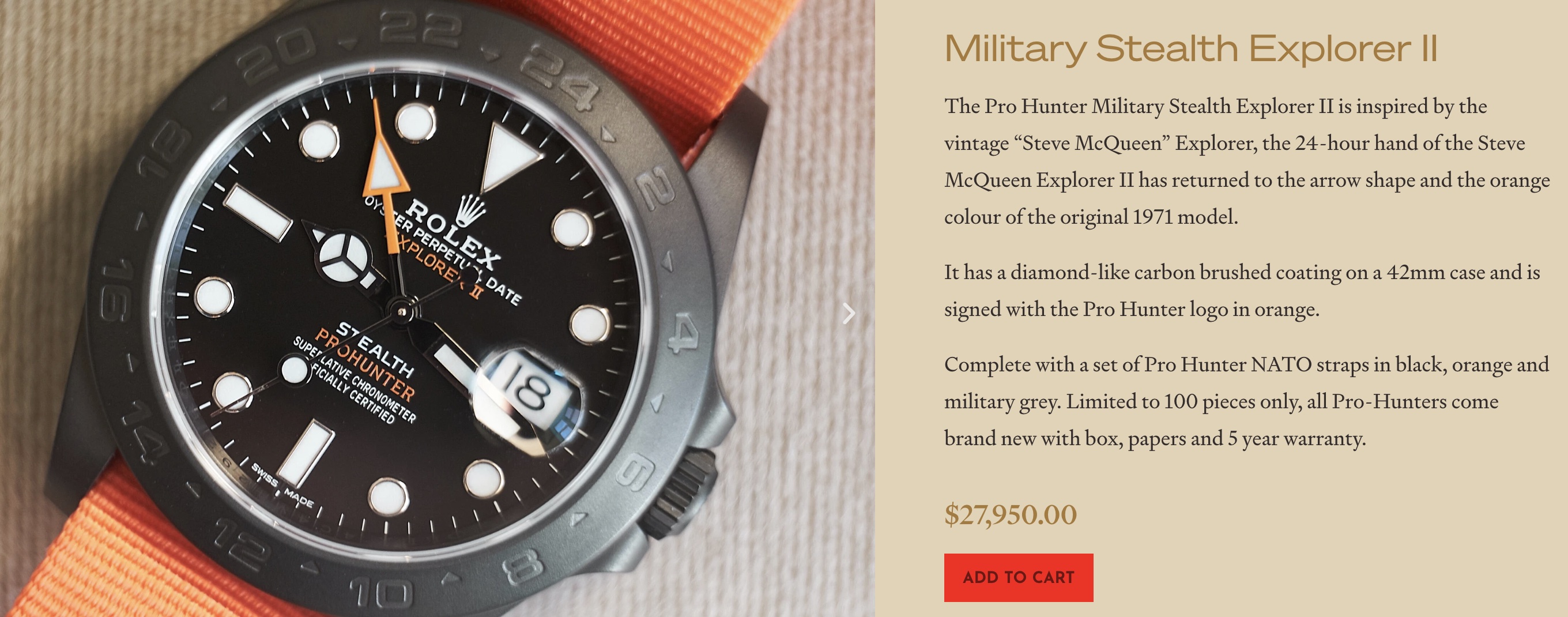
    Pro Hunter Military Stealth Explorer II

    Pro Hunter Military Stealth Explorer II — the Rolex that doesn’t announce itself. Source: American Optimist / Joe Lonsdale

    Alex Karp on American Optimist with Joe Lonsdale

    Alex Karp on American Optimist. Source: American Optimist / Joe Lonsdale

    ▶ Source: American Optimist with Joe Lonsdale — YouTube

    Alex Karp was not supposed to be a technology CEO. Born on October 2, 1967, and raised in Philadelphia by a physician father and an artist mother, he was drawn early toward ideas rather than institutions. He was dyslexic, socially independent, and — by his own account — consistently the outsider in any room he occupied. At Haverford College he studied social theory. At Stanford Law School he met a young Peter Thiel and found an intellectual sparring partner whose appetite for contrarian thinking matched his own. Then, rather than entering law or finance as expected, he flew to Frankfurt and spent nearly a decade studying under Jürgen Habermas — the philosopher of communicative reason, public discourse, and democratic legitimacy — completing his PhD in neoclassical social theory in 2002 at the age of 34. He also worked as a research associate at the Sigmund Freud Institute and built a small investment firm, the Caedmon Group, along the way. He was, by every conventional measure, the least likely person to co-found a defence technology company.

    In 2003, Karp and Thiel — joined by Joe Lonsdale, Stephen Cohen, and Nathan Gettings, most of them from the PayPal network — founded Palantir Technologies. The name came from Tolkien’s palantíri: seeing stones that allow their user to perceive events across great distances and through apparent darkness. The company’s original mission was to build data-integration and intelligence-analysis software that could help Western governments and their allies see what adversaries hoped to conceal. Contracts followed with the CIA, NSA, FBI, and the Department of Defence. Palantir’s technology is widely credited with playing a role in the 2011 operation that found Osama bin Laden. Karp’s insistence — unusual in Silicon Valley — that Palantir would only work with Western democracies and their allies, and would refuse lucrative contracts from authoritarian regimes, gave the company a moral architecture that he has defended publicly and at considerable cost.

    Palantir went public in September 2020. Karp was the highest-paid CEO of any publicly traded company that year, with compensation valued at $1.1 billion. In 2024 — the year The Economist named him its CEO of the Year — his compensation reached approximately $6.8 billion. Time magazine placed him on its 100 most influential people list in 2025. His net worth now exceeds $18 billion. None of this has moderated his presentation: the wild hair, the philosophical cadence, the willingness to tell audiences things they do not want to hear about technology, warfare, and the cost of Western complacency. When he appeared on Joe Lonsdale’s American Optimist, he was wearing a watch that fits the man precisely — and fits him in a way that requires some explanation.

    “Everyone here is doing something unique. We need to continue to attract and retain people who are different, think differently — and get them focused on the world’s most important missions.” — Alex Karp, Palantir Q4 2024 Earnings Call


    Timepiece

    Pro Hunter Military Stealth Explorer II

    Pro Hunter is a British watch modification specialist with a single philosophy: take Rolex’s most functional references and convert them into instruments that shed all visible luxury. The Military Stealth Explorer II begins life as a Rolex Explorer II — a watch with a 50-year lineage in exploration and field service — and submits it to a diamond-like carbon (DLC) brushed coating that eliminates every trace of the original’s bright finish. Steel, bezel, crown, bracelet: all blackened. The crown logo disappears. The Rolex signature remains on the dial, but the watch no longer announces itself from across a room.

    The tribute to the original 1971 “Steve McQueen” Explorer II is carried in the 24-hour hand — returned to the arrow shape and orange colour of the Ref. 1655 that started the lineage. The Pro Hunter orange logo is signed on the dial. The watch ships with three NATO straps: black, orange, and military grey. Limited to 100 pieces globally, all supplied new with box, papers, and five-year warranty. It is a Rolex that has chosen, deliberately, not to be seen as one.

    Reference Pro Hunter Military Stealth Explorer II (base: Rolex Explorer II, 42mm)
    Case 42mm, full DLC brushed coating; orange arrow 24-hour hand; NATO strap set
    Movement Rolex perpetual automatic (base calibre); COSC-certified
    Market price $27,950 (limited to 100 pieces; box, papers, 5-year warranty)

    A Seeing Stone That Prefers Darkness

    The Tolkien parallel runs deeper than Karp’s choice of company name. In the novels, the palantíri are used by those who understand that information is the oldest form of power — but the stones themselves are inert objects, invisible in function, dangerous only in the hands of someone who knows how to look. Karp has spent twenty years building an organisation whose entire value proposition is seeing clearly in conditions designed to obscure. His watch reverses the metaphor: it takes an object the whole world recognises on sight, and makes it opaque. The Pro Hunter Military Stealth Explorer II is a Rolex that has been trained not to reveal itself. Only the orange arrow hand — a quiet signal to those who know the 1971 lineage — gives the game away. Which is, of course, exactly the point.

    Why This Watch on This Wrist

    Alex Karp has described himself as an outsider among outsiders — biracial, dyslexic, philosophical, and constitutionally uninterested in performing the role that Silicon Valley expects of its billionaires. His company’s product is, at its core, about rendering the invisible visible. His watch does the inverse: it takes the world’s most visible luxury instrument and converts it into something that does not ask to be noticed. Limited to 100 pieces. No bright steel. No Rolex crown. Just an orange arrow and a matte black case that knows what it is without needing to announce it. For the philosopher-CEO who spent a decade in Frankfurt studying how institutions use language to exercise power — and then spent the next two decades building the tools that Western democracies use to see their adversaries — that is the precise right watch to wear into a conversation about the future of the world.


    More American Optimist Spots on Spot.Watch

    Why this watch, on this wrist?

  • Andrew Bustamante – Garmin Instinct Graphite Design

    Andrew Bustamante – Garmin Instinct Graphite Design

    Former CIA Covert Officer & Founder — EverydaySpy

    Andrew Bustamante’s Garmin Instinct: The Watch That Doesn’t Draw Attention

    Andrew Bustamante spent years operating as a covert CIA officer — a career built on the discipline of not being noticed. His Garmin Instinct Graphite is the watch that discipline produces: technically capable across every environment, visually anonymous, and entirely uninterested in impressing anyone. In intelligence work, that’s not a compromise. That’s the point.

    Andrew Bustamante, EverydaySpy

    Andrew Bustamante — EverydaySpy founder and former CIA covert officer.

    Garmin Instinct Graphite on Bustamante's wrist

    Garmin Instinct Graphite — rugged GPS watch with military-standard construction.

    Andrew Bustamante’s biography reads differently depending on which part of it you’re looking at. The public version — the one he now discusses openly — includes service as a US Air Force officer, recruitment into the CIA, and a career as a covert intelligence operative working across multiple international postings. The details he shares are selective by training and by necessity; the details he withholds are, presumably, the interesting ones. What he does discuss is the methodology: the systematic approach to human intelligence, influence, and situational awareness that he built into a curriculum through his company EverydaySpy, founded after leaving the agency.

    EverydaySpy translates CIA tradecraft into practical frameworks for civilians — reading people, managing influence, building situational awareness in everyday environments. Bustamante has become a fixture on podcasts and YouTube, presenting himself as a credible, grounded explainer of how intelligence professionals actually think rather than how Hollywood imagines they do. His audience skews toward the operationally minded: veterans, entrepreneurs, people who want to understand the mechanics of human behaviour at a level most personal development content doesn’t reach. He speaks precisely, moves deliberately, and wastes nothing — in conversation or, it appears, on his wrist.

    “Every tool you carry should have a reason to be there.” — Andrew Bustamante, EverydaySpy


    Timepiece

    Garmin Instinct — Graphite

    Garmin, founded in Olathe, Kansas in 1989, built its reputation on GPS navigation hardware for aviation, marine, and automotive applications before moving into wearables. The Instinct series, launched in 2018, applied that navigation expertise to a purpose-built rugged GPS watch — MIL-STD-810G certified for thermal, shock, and water resistance, with multi-GNSS support across GPS, GLONASS, and Galileo systems. It was designed for people who go into environments where a watch needs to work rather than simply look good.

    The Graphite colourway strips the Instinct to its most anonymous configuration — a dark grey fibre-reinforced polymer case that catches no light and attracts no second glances. The monochrome display is designed for readability in direct sunlight rather than for visual appeal in dim environments. GPS tracking, heart rate monitoring, barometric altimeter, compass, and up to 14 days of battery life in smartwatch mode make it the watch of someone who has thought carefully about what a watch is actually for.

    Reference Garmin Instinct — Graphite (010-02064-00)
    Case 45mm fibre-reinforced polymer; MIL-STD-810G; 100m water resistance
    Functions Multi-GNSS GPS, barometric altimeter, compass, heart rate, storm alert, up to 14-day battery
    Market price Retail ~$299 USD; widely available new and used

    Low Profile Is the Feature

    One of Bustamante’s recurring themes in his public teaching is the concept of the grey man — the intelligence principle of moving through environments without generating memory in the people who see you. Not invisible, but unremarkable. A person who passes through a room and leaves no strong impression is a person who can observe freely, operate without interference, and exit without being followed. Every choice a trained operative makes in public is filtered through that lens: clothing, posture, pace, and yes, what’s on the wrist.

    The Garmin Instinct Graphite is the grey man watch. At a glance it reads as a sports watch — common, functional, the kind of thing a runner or a hiker wears. It does not signal wealth. It does not signal brand allegiance. It does not invite conversation. What it does — invisibly, continuously — is track position, monitor environment, and provide navigation data that Swiss mechanical watchmaking cannot touch. For a former CIA officer who spent a career making consequential decisions in unfamiliar places, the Instinct Graphite is not a compromise on a Submariner. It is a deliberately superior choice for the operational context it was built for.

    The $299 Watch on the Wrist That Knows More Than You

    There is something quietly pointed about a man who could discuss the mechanics of human influence, geopolitical strategy, and covert operations for three hours straight — and does, regularly, with audiences in the millions — choosing to wear a $299 polymer watch. Bustamante’s brand is built on the argument that the most powerful tools are the ones most people overlook. The Instinct Graphite makes that argument on his wrist every time he appears on camera: capable, understated, and entirely unbothered by what anyone thinks of it. In EverydaySpy terms, that’s not a watch choice. That’s a field decision.

    Why this watch, on this wrist?

  • Brad Gerstner with a Audemars Piguet Royal Oak

    Brad Gerstner with a Audemars Piguet Royal Oak

    Investor & Fund Manager — American Optimist with Joe Lonsdale

    Brad Gerstner’s Audemars Piguet Royal Oak: The Watch That Thinks in Decades

    Brad Gerstner founded Altimeter Capital in the depths of the 2008 financial crisis with less than $3 million and a thesis the world thought was wrong: technology companies were immune to the wreckage. He was right, and the Audemars Piguet Royal Oak on his wrist tells the same kind of story.

    Brad Gerstner on American Optimist with Joe Lonsdale

    Brad Gerstner on American Optimist. Source: American Optimist / Joe Lonsdale

    Brad Gerstner Audemars Piguet Royal Oak detail

    The Royal Oak — a contrarian bet that became the defining luxury sports watch. Source: American Optimist / Joe Lonsdale

    ▶ Source: American Optimist with Joe Lonsdale — YouTube

    Brad Gerstner was not supposed to end up here. He grew up in Goshen, a small city in Elkhart County, Indiana, the kind of place better known for manufacturing recreational vehicles than minting Silicon Valley billionaires. He worked as chief of staff to Forest River founder Pete Liegl while still in high school — learning, even then, to study founders from the inside. He graduated summa cum laude from Wabash College, earned his law degree, spent a year as a securities attorney, then pivoted entirely: Harvard Business School, a founding role at General Catalyst, a run through early internet travel startups, and a portfolio manager position at PAR Capital. The résumé of a man who never stopped compounding.

    He founded Altimeter Capital on November 1, 2008 — six weeks after Lehman Brothers collapsed. The fund launched with less than $3 million from friends and family. His thesis was simple, and at the time wildly unfashionable: the financial crisis was a crisis of banks, not of technology. The internet supercycle was intact. Gerstner put his conviction on the table, and the market eventually agreed. Early positions in Zillow, Snowflake, MongoDB, and ByteDance built the case; Snowflake’s 2020 IPO — the largest software IPO in history at the time — confirmed it. Altimeter now manages roughly $7.5 billion.

    In October 2022, Gerstner published an open letter to Meta CEO Mark Zuckerberg, calling for a 20 percent reduction in headcount and a pullback from metaverse spending. It was the kind of public activism rarely seen from hedge fund managers in Silicon Valley. Within weeks, Meta announced layoffs of over 11,000 employees. The episode cemented Gerstner’s reputation as someone willing to say in writing what others whisper in boardrooms. His BG2Pod — co-hosted with venture capitalist Bill Gurley — has since become a touchstone for serious tech investing conversation, blending first-principles analysis with the kind of candour that is hard to find in a world of managed messaging.

    When Gerstner sat down with Joe Lonsdale on American Optimist, the discussion covered AI investment cycles, industrial policy, and the national security dimensions of the technology race with China. On his wrist was an Audemars Piguet Royal Oak — one of the most recognised timepieces in finance. The choice was neither accidental nor decorative.

    “We’ve lived through three supercycles — internet, social, mobile and cloud — and each ended up far bigger than we thought. AI is next.” — Brad Gerstner, Altimeter Capital


    Timepiece

    Audemars Piguet Royal Oak Selfwinding — Ref. 15510ST.OO.1320ST.01

    Few watches carry as much mythology per millimetre as the Royal Oak. Designed by Gérald Genta and introduced in 1972, it was built from stainless steel at a price point that horrified the Swiss establishment — steel watches were tool watches, not luxury objects. The industry’s conventional wisdom was wrong. The Royal Oak became the founding document of the luxury sports watch category, and Audemars Piguet, the independent manufacture in Le Brassus in the Swiss Vallée de Joux, has remained the benchmark against which every competitor is measured.

    The 15510ST, introduced in 2021 as the successor to the long-running 15400ST, brings the case diameter to 41mm and debuts Calibre 4302 — a movement with a 70-hour power reserve, improved accuracy, and a new architecture that will underpin AP’s steel Royal Oak line for the next generation. The hallmark octagonal bezel with its eight hexagonal screws, the integrated steel bracelet, and the “Grande Tapisserie” guilloché dial remain non-negotiable. The 15510ST is, at any given moment, among the most sought-after watches in the world.

    Reference 15510ST.OO.1320ST.01 (Blue “Grande Tapisserie” dial)
    Case 41mm stainless steel, sapphire crystal caseback, 50m water resistance
    Movement Calibre 4302, automatic, 70-hour power reserve, ~38 hours at retail ±2 sec/day
    Market price Retail ~$27,300; secondary market $35,000–50,000+ (allocation-dependent)

    Two Contrarian Bets — One in 1972, One in 2008

    The Royal Oak and Altimeter Capital share a founding logic. In 1972, Gérald Genta presented a steel sports watch to a market that bought luxury in gold. The objections were immediate and almost universal — who would pay that much for steel? Audemars Piguet ran the experiment anyway. In 2008, Brad Gerstner raised less than $3 million and told investors that a banking collapse was not a technology collapse. The objections were immediate and almost universal — who starts a fund in a depression? Gerstner ran the experiment anyway. Both bets required the kind of patience that resists the pressure of the room. Both were right on a long enough timeline.

    This is the specific quality the Royal Oak signals in tech and finance circles that goes beyond status. Plenty of executives wear expensive watches as trophies. The Royal Oak, for those who understand its history, signals something else: a tolerance for being misunderstood in the short run, and a confidence in long-cycle thinking. For a man who wrote an open letter to Meta’s board, publicly called the AI transition a “Manhattan Project” moment, and co-hosts a podcast arguing that America’s tech edge is a national security asset, the watch is on-brand in the most literal sense.

    Why This Watch on This Wrist

    Gerstner has spent his career identifying supercycles — inflection points where the consensus is wrong, the patient capital wins, and the late money chases a narrative that was written years earlier. The Royal Oak is the horological version of that thesis: a watch that was wrong by every conventional measure in 1972, and has been relentlessly right for over fifty years since. On a wrist that has made billion-dollar bets on Snowflake, ByteDance, and now AI infrastructure, it reads less like a luxury purchase and more like a statement of method. Brad Gerstner does not pick the obvious trade. He picks the durable one.


    More Audemars Piguet Royal Oak Spots on Spot.Watch

    Why this watch, on this wrist?

  • Andrew Sorkin with a Rolex Sea-Dweller on CNBC Squawk Box

    Andrew Sorkin with a Rolex Sea-Dweller on CNBC Squawk Box

    CNBC Squawk Box  ·  The New York Times  ·  DealBook  ·  Too Big to Fail

    Andrew Ross Sorkin’s Rolex Sea-Dweller: The Journalist Who Goes Deep Wears a Watch Built for It

    Andrew Ross Sorkin covers the financial system at its foundations — crashes, mergers, the moments when power and money intersect in ways that reshape everything. The Rolex Sea-Dweller on his Squawk Box wrist is a professional tool watch, built for depth, not display. It fits precisely.

    Andrew Ross Sorkin on CNBC Squawk Box. Source: CNBC

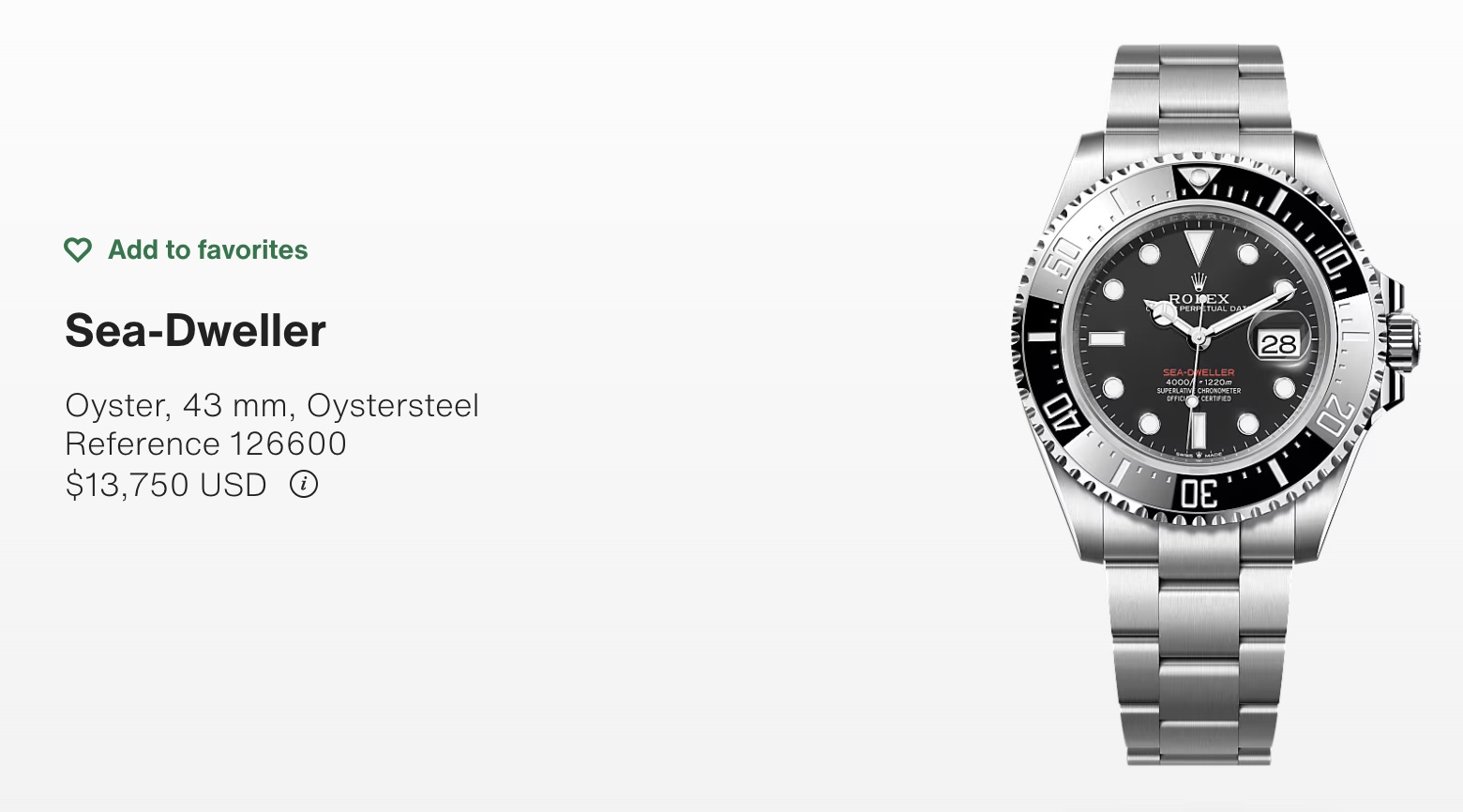
    Rolex Sea-Dweller Ref. 126600 in Oystersteel.

    Andrew Ross Sorkin was born in New York City in 1977, the son of a playwright and a corporate attorney. He graduated from Cornell University in 1999 with a degree in communication and joined The New York Times shortly after — and has, in the quarter-century since, become one of the most consequential business journalists working in any medium. In October 2001, while still a reporter in his mid-twenties, he founded DealBook, a daily financial newsletter published by the Times. It was one of the first financial news aggregation services on the internet, and it grew into something considerably larger: an annual conference that draws the most senior figures in finance, technology, and policy, and a franchise that has shaped how the business world reads its own news.

    His 2009 book Too Big to Fail — a reported account of the 2008 financial crisis reconstructed from hundreds of sources inside the rooms where the decisions were made — won the Gerald Loeb Award for Best Business Book, was shortlisted for the Samuel Johnson Prize and the Financial Times Business Book of the Year, and was adapted as an HBO film nominated for eleven Emmy Awards. In October 2025, he published 1929: Inside the Greatest Crash in Wall Street History — and How It Shattered a Nation, an instant New York Times bestseller named a best book of 2025 by Time, The Economist, the Financial Times, and Bloomberg. Both books operate at the same level: not commentary on financial events, but primary-document reconstruction of what actually happened, told from inside.

    Since 2011, Sorkin has co-anchored CNBC’s Squawk Box, the network’s flagship morning programme, live from 6 to 9am Eastern. He is also the co-creator of Billions, the Showtime drama starring Paul Giamatti and Damien Lewis — a series set in the world of hedge funds and federal prosecution that, among other things, demonstrated Sorkin’s detailed understanding of the culture, the language, and the objects that signal status in that world. He knows what a watch says on a given wrist. The Sea-Dweller on his own is not an accident.

    “The story of 2008 is not a story about the economy. It’s a story about people making decisions under pressure — in real time, without knowing how it ends.” — Andrew Ross Sorkin, on Too Big to Fail


    Timepiece

    Rolex Sea-Dweller — Ref. 126600, Oystersteel

    The Rolex Sea-Dweller was developed in the 1960s in collaboration with professional saturation divers — men working at extreme depths for extended periods, in conditions that destroyed conventional diving watches. The Sea-Dweller solved two problems its predecessor the Submariner could not: it added a helium escape valve to vent the gas that accumulated during decompression inside diving bells, and it achieved a water resistance of 1,220 metres — four times that of the Submariner at the time. It was a tool, built to a professional specification, not a sport watch dressed as one.

    The current Ref. 126600, relaunched in 2017 with a 43mm case and the distinctive single-line red Sea-Dweller text on the dial, runs the Calibre 3235 — Rolex’s modern workhorse movement, delivering a 70-hour power reserve, bidirectional Perpetual rotor, and COSC chronometer certification. The Glidelock Oyster bracelet allows 2mm of fine adjustment without tools — a practical feature that reflects the watch’s working-tool DNA throughout.

    Reference 126600 — Oystersteel, 43mm
    Case 43mm Oystersteel, unidirectional ceramic bezel, sapphire crystal, 1,220m water resistance
    Movement Calibre 3235, automatic, 70-hour power reserve, COSC-certified, helium escape valve
    Market price ~$11,550 retail; secondary market ~$11,000–$14,500

    A Tool Watch for a Reporter Who Works in Depth

    The Sea-Dweller is not a watch that announces itself in the way a Daytona or a Day-Date does. It is steel, not gold. Its dial is functional — the bezel tracks elapsed time, not prestige. At 43mm it wears substantially on the wrist, but it does so without ornamentation. In the world Sorkin covers, where a Patek Philippe or an AP Royal Oak signals private equity money and a gold Rolex signals a certain kind of ambition, the Sea-Dweller sits in a different register entirely: it is the watch of someone who is not performing wealth but is not indifferent to precision.

    Sorkin co-created Billions, a series populated with characters whose watch choices are deliberate narrative signals — the show’s costume department treats timepieces as character exposition. That Sorkin himself wears the Sea-Dweller to his own broadcast is the kind of detail the show would notice. It is not the watch of a hedge fund manager or a Wall Street banker. It is the watch of someone who covers those people for a living and has no need to dress like them.

    Why This Watch on This Wrist

    Andrew Ross Sorkin’s career has been built on going deeper than the surface account — into the rooms, the phone calls, the decisions made at 2am during the 2008 crisis, the panic behind the composure of the men who were supposed to have answers. Too Big to Fail and 1929 are not analysis pieces; they are reconstructions, sourced from primary documents and participants, written with the rigour of someone who understands that the interesting story is always underneath the one being reported. The Sea-Dweller was designed for people who literally work below the surface — professional divers for whom pressure is not a metaphor but a physical condition. On Sorkin’s wrist at a 6am broadcast desk, the metaphor is available but the watch earns it: a precision instrument worn by a journalist who has spent twenty-five years going places in his reporting that most reporters don’t reach, and staying there long enough to bring something back.

    Why this watch, on this wrist?

  • Davante Adams, Rams Wide Receiver Sporting a Audemars Piguet Royal Oak

    Davante Adams, Rams Wide Receiver Sporting a Audemars Piguet Royal Oak

    Wide Receiver, Los Angeles Rams — Club Shay Shay

    Davante Adams’ Audemars Piguet Royal Oak: The Watch That Was Once Dismissed on the Wrist of a Player Who Was Too

    Spotted on Club Shay Shay: Davante Adams wearing an Audemars Piguet Royal Oak. The only player in NFL history to lead the league in receiving touchdowns with three different teams — Packers, Raiders, Rams. The watch was designed overnight in 1972, dismissed as too strange and too expensive, and became the defining luxury sports watch of its era. The pairing is not accidental.

    Davante Adams wearing Audemars Piguet Royal Oak on Club Shay Shay

    Davante Adams — AP Royal Oak on wrist. Source: Club Shay Shay

    Davante Adams Audemars Piguet Royal Oak detail

    Audemars Piguet Royal Oak — octagonal bezel, tapisserie dial, integrated bracelet

    Davante Lavell Adams was born December 24, 1992, in East Palo Alto, California — one of the Bay Area’s more economically challenged communities, pressed against the prosperous city of Palo Alto by geography but separated from it by circumstance. He attended Palo Alto High School across the border in Palo Alto proper, where he was a two-way starter in his senior season: 64 receptions, 1,094 yards, 12 touchdowns on offence; 44 tackles, two forced fumbles, an interception on defence. He led the school to a CIF state championship. He also played basketball seriously enough to be considered a two-star recruit. The football and basketball résumé was real. The academic record was not. By the time college coaches came looking, Adams had put himself in a hole with his grades in his first two years that nearly cost him his opportunity altogether.

    Keith Williams, then a receivers coach at Fresno State, had come to Palo Alto High School looking at a different player entirely. He only learned about Adams because the head coach mentioned there was another receiver worth seeing. When Williams checked Adams’ academic status, the news was poor — he hadn’t qualified yet going into his final semester, and even the schools that knew about him were hesitant. Adams took eight classes in his senior year while most students were taking four, dug himself out of the hole he had built, and enrolled at Fresno State. He played two seasons for the Bulldogs, set school career records for receptions and touchdowns despite only two years of eligibility, led the nation in 2013 with 1,719 receiving yards and 24 touchdown receptions — a Mountain West Conference record — and declared for the draft before his junior season even began.

    The Green Bay Packers selected him in the second round, 53rd overall, in the 2014 NFL Draft. He arrived behind Jordy Nelson and Randall Cobb in the depth chart, finished his first two seasons with modest numbers, and by his third year had begun to establish what he was becoming. From 2018 through 2021 he was arguably the best wide receiver in football — three seasons of 110-plus catches, 1,350-plus yards, and 11-plus touchdowns, a combination no player in NFL history has matched. He and Aaron Rodgers became one of the most productive quarterback-receiver pairings of the modern era. In 2022 he was traded to the Las Vegas Raiders for a first- and second-round pick, signed a five-year, $141 million deal that made him the highest-paid wide receiver in NFL history at the time, broke the Raiders’ single-season receiving yard record in his first season there, and led the league in touchdown receptions again. In 2025 he signed with the Los Angeles Rams, led the NFL in touchdown receptions for a third time with a different team, and became the only player in league history to accomplish that.

    “He hadn’t qualified yet going into the final semester of his senior season. My junior and senior year in high school, I had to really dig deep.” — Davante Adams, on his early academic struggles


    Timepiece

    Audemars Piguet Royal Oak

    On the evening of April 10, 1971 — the night before the annual Basel Watch Fair — the managing director of Audemars Piguet called Gérald Genta, the most celebrated watch designer of his generation, and asked for a complete design by morning. The brief: an “unprecedented steel watch,” something that had never been done before. Genta, drawing inspiration from a traditional diver’s brass helmet — octagonal, bolted shut with exposed screws to maintain pressure — produced a sketch overnight. The result was the Royal Oak reference 5402ST, unveiled at Basel in 1972: an octagonal bezel secured by eight visible hexagonal screws, a blue tapisserie dial with its distinctive crosshatch pattern chosen from 300 candidate designs, and an integrated bracelet machined from a single block of steel so complex to manufacture that the first prototypes had to be made in white gold because no factory could cut steel to Genta’s tolerances quickly enough.

    At launch the Royal Oak was priced at 3,300 Swiss francs — more expensive than a gold Patek Philippe Calatrava, more than ten times the price of a Rolex Submariner. For a stainless steel sports watch, this was considered absurd. Watch industry commentators were baffled. Sales were slow. AP ran advertisements that leaned into the controversy: “The costliest stainless steel watch in the world.” And then, gradually, the market caught up with the design. The Royal Oak became the template for the entire luxury sports watch category — the watch that proved a steel watch with an industrial aesthetic could be more desirable, more status-laden, and more expensive than a precious metal dress watch. Gerald Genta also designed the Patek Philippe Nautilus in 1976 and the IWC Ingenieur. All three drew from the same design language. None matched the cultural weight of the Royal Oak. Today it is one of the most sought-after and recognised watches in the world, worn by athletes, musicians, executives, and collectors who understand that its value was earned, not inherited.

    Origin Designed by Gérald Genta overnight — unveiled Basel 1972
    Case Octagonal bezel — 8 exposed hexagonal screws — integrated bracelet
    Material Stainless steel (also available: gold, two-tone, titanium)
    Dial Petite Tapisserie — blue, black, grey, or white depending on ref.
    Movement Caliber 7121 (Jumbo) / 3120 / 4302 depending on reference
    Water resistance 50 metres (standard) / 100 metres (Offshore)
    Market value From ~$25,000 USD (steel) — secondary market often considerably higher

    The Parallel

    The Royal Oak was designed in one night and dismissed as too odd and too expensive. Davante Adams nearly didn’t qualify academically for college, was only found because a coach happened to mention him to a recruiter who had come to see someone else, and arrived in the NFL as a second-round pick behind two established wide receivers on a team that didn’t immediately need what he could do. Both of them required patience and time and the right context before the people around them understood what they were looking at.

    The Royal Oak became the template for the entire luxury sports watch category — the watch that changed what steel could mean in haute horlogerie. Adams became the only player in NFL history to lead the league in receiving touchdowns with three different teams — with three different quarterbacks, in three different offensive systems — which is a different kind of historical singularity, and perhaps a better one, because it removes the variable of having one exceptional quarterback and isolates the receiver himself as the constant. The Royal Oak on his wrist at Club Shay Shay is not a coincidence of taste. It is a recognition of category.

    The Watch the Culture Chose

    The Royal Oak has become the watch that NFL and NBA athletes reach for when they want to signal serious taste rather than simple wealth. The Submariner signals arrival; the Royal Oak signals that the wearer knows the difference between arrival and understanding. It requires engagement — knowing what the octagonal bezel means, why the tapisserie pattern exists, who Gérald Genta was and what he accomplished on one phone call and one night’s work. Davante Adams, appearing on Shannon Sharpe’s podcast wearing it, is participating in that conversation. He came from East Palo Alto with bad grades and eight classes in one senior year and is now the only man in the history of his sport to do something that no one else has done three times over. The Royal Oak belongs on that wrist.

    Why this watch, on this wrist?
  • Charles Barkley on Club Shay Shay with a Parmigiani Fleurier

    Charles Barkley on Club Shay Shay with a Parmigiani Fleurier

    Club Shay Shay  ·  TNT Inside the NBA  ·  NBA Hall of Fame

    Charles Barkley’s Parmigiani Fleurier: The Loudest Man in Basketball Wears the Quietest Luxury Watch

    Charles Barkley has built a second career on saying exactly what he thinks, at volume, on national television. The Parmigiani Fleurier on his wrist during Club Shay Shay is built on the opposite principle — restraint over spectacle, beauty that reveals itself over time. The contrast between the man and the watch is the whole story.

    Charles Barkley on Club Shay Shay with Shannon Sharpe. Source: Club Shay Shay / YouTube

    Parmigiani Fleurier — the connoisseur’s watch, identified on Barkley’s wrist at Club Shay Shay.

    Charles Barkley was born in 1963 in Leeds, Alabama, a small steel-industry town outside Birmingham. He grew up without his father, raised by his mother and grandmother in circumstances that were modest in every material sense. He was not highly recruited out of high school — too short, scouts said, for a power forward at the college level. Auburn University took a chance. What followed was a career built on proving, continuously, that the conventional assessment of what he could and could not do was wrong.

    The Philadelphia 76ers drafted him fifth overall in 1984, and for the next eight seasons he was one of the most dominant and entertaining players in the league — a six-foot-four power forward who routinely outrebounded and outmuscled men four and five inches taller, playing with a physicality and competitive fury that made the size objection seem absurd in retrospect. He was traded to the Phoenix Suns in 1992, earned the NBA MVP that same season, and took the Suns to the Finals — losing to the Chicago Bulls in six games. He spent his final seasons with the Houston Rockets before retiring in 2000. Eleven All-Star selections, two Olympic gold medals (1992, 1996), and the Hall of Fame in 2006. The one thing he never won was an NBA championship, a fact that his critics occasionally raise and that he addresses with a directness bordering on philosophical: he played to win, he came close, it didn’t happen.

    The broadcasting career that followed has lasted longer than the playing career. Since joining TNT’s Inside the NBA in 2000 alongside Ernie Johnson, Kenny Smith, and eventually Shaquille O’Neal, Barkley has become one of the most consistently compelling voices in sports media — willing to say things on live television that most analysts calculate carefully before approaching. His Nike commercial declaring “I am not a role model” was considered incendiary in 1993. His Club Shay Shay appearance with Shannon Sharpe produced the kind of unguarded conversation that long-form podcast formats exist to capture: two outspoken Hall of Famers with nothing to prove and no reason to be diplomatic.

    “I know I’m going to the Hall of Fame. That’s not an issue. The only issue is whether I’m going in as a player or as a legend.” — Charles Barkley


    Timepiece

    Parmigiani Fleurier — Believed to be Tonda PF Collection

    Note: Specific model unconfirmed from image — brand identified as Parmigiani Fleurier

    Parmigiani Fleurier was founded in 1996 by Michel Parmigiani in the Val-de-Travers region of Switzerland, in the village of Fleurier. Parmigiani was not a businessman who decided to start a watch company — he was one of the world’s foremost watchmaker-restorers, a man who had spent decades disassembling and rebuilding the most complicated timepieces ever made for the Sandoz Family Foundation’s collection. When the Foundation backed the creation of the brand, it was because they had watched Parmigiani work for years and understood what he was capable of. The result is one of the few truly integrated manufactures in Swiss watchmaking: Parmigiani produces its own movements, cases, and dials entirely in-house, across several subsidiary workshops in the Jura.

    The Tonda PF, launched in 2021 to mark the brand’s 25th anniversary, is the collection that has defined Parmigiani’s contemporary identity: a round luxury sports watch with teardrop lugs, a hand-knurled platinum bezel, an ultra-fine Grain d’Orge guilloché dial, and a discreet PF medallion at 12 o’clock. The brand’s stated philosophy for the collection: “restraint and integrity take precedence over spectacle.” Starting prices for steel models begin around $21,000; gold and platinum pieces with complex complications exceed $150,000.

    Founded 1996, Fleurier, Switzerland — Michel Parmigiani, founder
    Flagship Tonda PF — round, guilloché dial, platinum knurled bezel, teardrop lugs
    Movement In-house manufacture calibres — micro-rotor, chronograph, tourbillon, perpetual calendar
    Market price From ~$21,000 (Tonda PF steel); $150,000+ for complex precious metal references

    The Watch That Doesn’t Announce Itself

    Parmigiani Fleurier is not a brand that most people in any given room will recognise on sight. That is not an accident — it is a design philosophy. The Tonda PF was built explicitly for collectors who value coherence over display and quiet beauty over persuasion. Where a Royal Oak’s integrated bracelet announces its identity to anyone with a passing familiarity with luxury watches, and where a Nautilus can be identified from the other side of a restaurant, the Tonda PF tends to be noticed by the people who know what to look for and passed over by everyone else. The knurled platinum bezel, the guilloché dial, the teardrop lugs — these are details that reward attention. They do not demand it.

    Barkley wearing this brand at this level of understated prestige is the watch equivalent of a man who has spent thirty years as the most visible person on every platform he has ever occupied choosing, for one moment, to let the object speak quietly. It suggests a collector who has moved past the watches that signal to everyone and arrived at the watches that signal only to the right people.

    Why This Watch on This Wrist

    Charles Barkley grew up in Leeds, Alabama, was told he was too small to play power forward, and spent the next decade proving that assessment definitively wrong through force of will, physical intelligence, and a competitive disposition that had nothing to do with what the scouts thought. He has never needed permission from the room to do what he was going to do anyway. The Parmigiani Fleurier on his wrist at Club Shay Shay operates in that same register: it is not there for validation from the room. It does not require the room to know what it is. It is correct, quietly, in the way that things chosen by someone who has thought carefully and arrived at a conclusion tend to be. Sir Charles does not need to explain his watch. He has never needed to explain anything.

    Why this watch, on this wrist?

  • Danial Cormier on Club Shay Shay with a Panerai

    Danial Cormier on Club Shay Shay with a Panerai


    UFC color commentator

    Daniel Cormier: UFC Commentator


    Daniel Cormier

    Daniel Cormier

    Daniel Cormier

    Daniel Cormier

                                                                     Daniel Cormier (often called “DC”) is an American former professional mixed martial artist, freestyle wrestler, and current UFC color commentator.

    Born in 1979 in Lafayette, Louisiana, he is widely regarded as one of the greatest MMA fighters ever. He is a former two-division UFC champion (Light Heavyweight and Heavyweight), the second fighter in UFC history to hold titles in two weight classes simultaneously, and the first to defend titles in both divisions. Before MMA, he had a decorated wrestling career, including Olympic team appearances and a World bronze medal.   en.wikipedia.org

    “Success leaves clues — study those who’ve already built what you want to build.”


    Timepiece

    Panerai Submersible

    Panerai Submersible is a professional diving watch collection from the Italian luxury brand Panerai. It features bold, cushion-shaped cases with a distinctive crown-protecting bridge, high water resistance (often 300m to 2,500m), unidirectional rotating bezels for timing dives, and advanced materials like steel, Carbotech, or BMG-Tech. Originally tied to the Luminor line and inspired by Panerai’s naval heritage, it became a standalone collection in 2019 and is designed as a rugged, reliable tool for underwater exploration.   panerai.com