Author: Gabby

  • Hamilton’s Khaki Field film leans on field watch lore

    NEW VIDEO

    Hamilton’s Khaki Field film leans on field watch lore

    Hamilton’s new Khaki Field film links the line to the shift after World War I from pocket watches to wristwatches for troops, calling the Khaki Field Mechanical "the original field watch." The current reference (H69439931) is 38mm steel with a hand wound movement, 80 hour power reserve, and $675 price.

    Hamilton’s new Khaki Field film links the line to the shift after World War I from pocket watches to wristwatches for troops, calling the Khaki Field Mechanical “the original field watch.” The current reference (H69439931) is 38mm steel with a hand wound movement, 80 hour power reserve, and $675 price.

    Source: youtube.com

    Why this watch, on this wrist?

  • Patek Philippe lists the Gondolo Ladies First Joaillerie Ref. 7043/250GR-001

    Patek Philippe lists the Gondolo Ladies First Joaillerie Ref. 7043/250GR-001

    DROP

    Patek Philippe lists the Gondolo Ladies First Joaillerie Ref. 7043/250GR-001

    Patek Philippe has added the Gondolo Ladies First Joaillerie Ref. 7043/250GR-001 to its 2026 collection, offering the shaped dress watch in a two tone execution on the brand’s product page.

    The watch features a white and rose gold case, 31 x 34.8 mm and 8.03 mm thick, with 30 m water resistance and Patek’s quartz Caliber E15. The listed price for this two tone reference is $68,768.

    Collectors will note the Gondolo’s distinctive form: a Patek shape where the case defines the watch’s personality, while the movement remains discreet. Patek’s collection finder groups this reference under 7043/250, with white gold, rose gold and two tone versions available for 2026.

    Reference7043/250 (family name covering three current SKUs, 7043/250G-001, 7043/250R-001, 7043/250GR-001)
    Price$68,768
    Released2026 (as listed on Patek's current-collection finder; no specific month/day given)
    Case31 x 34.8 mm, 8.03 mm, White gold and rose gold
    MovementE15 Quartz
    Water Resistance30m

    Source: patek.com

    Why this watch, on this wrist?

  • Hamilton Shows the American Classic Boulton Quartz and Its Indiana Jones Connection

    NEW VIDEO

    Hamilton Shows the American Classic Boulton Quartz and Its Indiana Jones Connection

    Hamilton’s new video puts the American Classic Boulton Quartz, Ref. H13431553, in focus, tracing its 1940s style cues through its recent screen role in Indiana Jones and the Dial of Destiny. It is a quick look at why the Boulton remains one of Hamilton’s most recognizable heritage shapes, with a clear link between vintage charm and modern storytelling.

    Why this watch, on this wrist?

  • Christopher Ward marks 15 years of JJ01 with the C1 Jump Hour XV

    NEW VIDEO

    Christopher Ward marks 15 years of JJ01 with the C1 Jump Hour XV

    Christopher Ward’s 15 years of pure JJ01 marks the JJ01 module launched in 2011 and introduces the C1 Jump Hour XV, a rare accessible 300 piece jumping hour listed on the product page at $2,495. The description connects JJ01, developed with Johannes Jahnke for the C9 Harrison Jumping Hour, to the JJ Calibres, Bel Canto and Atelier; the page lists 39mm steel, Sellita SW200-1 with JJ01 module, and pre-order for Mid December 2026, while the video says “available now.”

    Source: youtube.com

    Why this watch, on this wrist?

  • Timex explains Family Connect for keeping kids connected on T-Mobile

    LOOK BACK

    Timex explains Family Connect for keeping kids connected on T-Mobile

    This older upload from Timex’s own channel introduces Family Connect, a cellular watch for kids on T-Mobile. It is worth a quick look as a snapshot of Timex’s connected watch pitch in 2019, focused on letting parents and guardians communicate with children and monitor them from the wrist.

    Why this watch, on this wrist?

  • How Henry Archer Defines Sector Dials Through ARKONA and ØHAV

    How Henry Archer Defines Sector Dials Through ARKONA and ØHAV

    WATCH STORY

    How Henry Archer Defines Sector Dials Through ARKONA and ØHAV

    Henry Archer’s journal breaks down sector dials through its ARKONA and ØHAV models, showing how concentric zones, tracks, texture, and depth shape the design.

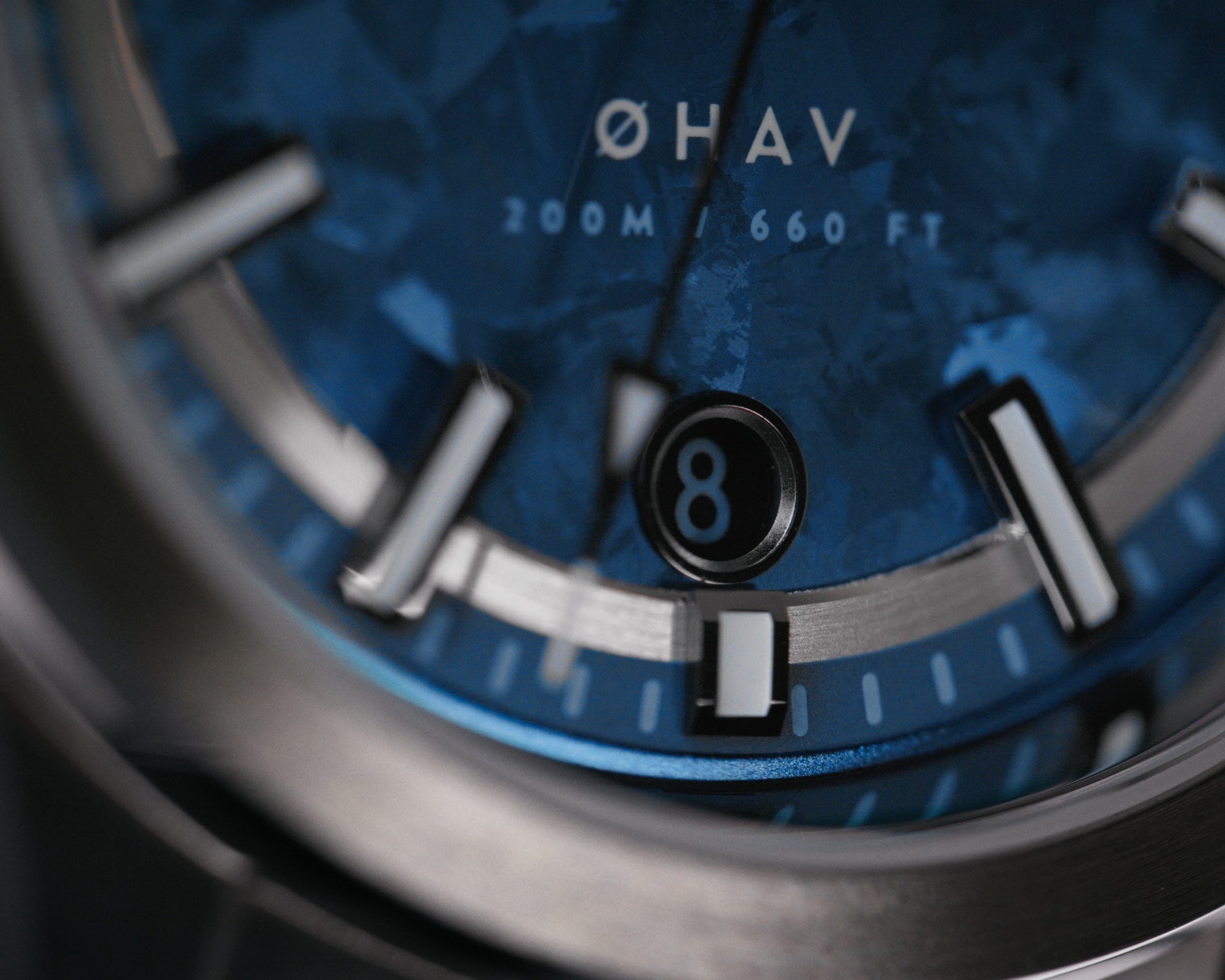
    In Henry Archer’s journal, the Danish microbrand defines the form as a dial organized into distinct sectors, most often through concentric circular zones. Its working taxonomy is fourfold: circular zones, defined tracks, contrast or texture, and physical depth.

    The modern examples are concrete. ARKONA is presented as the texture led version, with a CNC machined guilloché centre inspired by small movements and waves on water, then surrounded by rings that read as ripples.

    ØHAV is the depth led version. The journal says its dial is built from several physical layers, with that construction becoming clearer when viewed through a loupe.

    The distinction matters for collectors: Henry Archer is not just invoking a vintage look. It separates design into geometry, surface treatment, and physical construction.

    Source: henryarcher.com

    Why this watch, on this wrist?

  • Vaer announces official USPS collaboration, the C5 Postmaster

    Vaer announces official USPS collaboration, the C5 Postmaster

    DROP

    Vaer announces official USPS collaboration, the C5 Postmaster

    The small US assembly brand is teasing a field watch made under license with the United States Postal Service.

    Vaer C5 Postmaster

    Image: Vaer

    Vaer has announced the C5 Postmaster, an officially licensed collaboration with the United States Postal Service, in a journal teaser.

    The watch is described as a field watch, with final assembly handled in the United States by Vaer’s team. The full reveal arrives in the middle of October, when the model goes on sale exclusively through Vaer’s site.

    The postal theme extends to delivery. Vaer writes, “It ships through USPS only.” The stated checkout options are Ground Advantage and Priority Mail.

    For collectors, the draw is less the specs than the license itself. An official USPS watch is rare, especially from a microbrand, and it fits Vaer’s Americana focus.

    ReleasedOn sale mid-October, exclusively at vaerwatches.com
    SpecsField watch, US-assembled

    Source: vaerwatches.com

    Why this watch, on this wrist?

  • RZE Highlights the Titanium Endeavour Dive Watch

    LOOK BACK

    RZE Highlights the Titanium Endeavour Dive Watch

    This older upload from RZE’s own channel puts the Endeavour in focus, presenting the titanium dive watch as a sea minded piece made for travel above and below the water. It is worth a quick watch for a concise brand view of the model’s tool watch intent and voyage ready positioning.

    Why this watch, on this wrist?

  • How to Read a Decompression Timer Dial

    How to Read a Decompression Timer Dial

    FACT OF THE DAY

    How to Read a Decompression Timer Dial

    Four rings, one minute hand and a table printed on the dial: the logic behind a display dive computers retired, and why Ocean Crawler still builds one.

    A decompression timer dial is, in Ocean Crawler’s words, “a specially designed watch dial with concentric circles representing depth and time readings.” The Rochester, New York microbrand walked through how it works in a September 23, 2026 guide bylined Christian Champion, and its own Decompression Timer puts the idea on the wrist.

    Each ring stands for a maximum depth. On Ocean Crawler’s watch, a scale at 12 o’clock lists four bands: 25, 30, 35 and 40 meters on the left, with 85, 100, 115 and 135 feet on the right. The diver picks the ring that matches the deepest point of the planned dive. Numbers around that ring mark elapsed dive time, and the figures beside them give the length of the stop needed before surfacing, made at a shallow depth, typically 3 to 5 meters.

    “The system depends totally on the minute hand of the watch,” the guide says. Ocean Crawler’s instructions have the diver start with the minute hand at 12, then watch where it falls on the chosen ring. On the innermost ring, covering 25 to 29 meters, no stop is called for until 34 minutes; a dive of 35 to 40 minutes calls for a five-minute stop, and 41 to 50 minutes calls for twenty. Only then does the bezel come in. The diver turns it so the numeral for the stop length (20 for a 20-minute stop) sits at the minute hand, and surfaces when the hand reaches the luminous zero marker.

    The color-coded look the guide describes is older than Ocean Crawler. Mido’s Ocean Star Decompression Timer of 1961 marked its depth bands in yellow for 25 to 29 meters, green for 30 to 34, pink for 35 to 39 and blue for 40 to 44. Paul Wessel’s US patent 3,475,902 for a “Diver’s watch,” filed in 1968 and granted in 1969, works on the same principle, down to a stop “at a depth of 3 meters during 5 minutes.” Ocean Crawler’s own dial swaps the rainbow for orange and cream rings.

    One caveat, stated plainly: a dial like this is a fixed table. It cannot account for repetitive dives, ascent rate or breathing gas, and it is no substitute for a dive computer and proper training. Read it as a record of how diving used to be planned.

    WatchOcean Crawler Decompression Timer (Core Diver); blue, black, yellow and black DLC versions
    MovementSellita SW200-1 automatic, 28,800 vph, regulated
    DialFour decompression rings, 25 to 40 m (85 to 135 ft)
    BezelUnidirectional, sapphire insert, Swiss C3 lume
    Water resistance2,000 ft, per Ocean Crawler
    Edition100 numbered pieces per color
    Price$1,099 (yellow listed at $999 on sale as of September 30, 2026)

    Why this watch, on this wrist?

    Nobody straps on a Decompression Timer to plan a dive in 2026. It earns its place because it keeps a working tool legible: a dive table printed on the dial, from an era when the watch was the dive computer. At $1,099, in runs of 100 per color with a Sellita inside, it is one of the more attainable ways to wear that idea, on a wrist that knows how to read it.

    Sources: Ocean Crawler guide · Ocean Crawler Decompression Timer · Swatch Group (Mido) · US3475902A

    And at Spot.Watch — that’s always worth noticing.

  • Raymond Weil’s Millesime Jubilee: A 500 Piece Chronograph for 50 Years of Independence

    Raymond Weil’s Millesime Jubilee: A 500 Piece Chronograph for 50 Years of Independence

    DROP

    Raymond Weil’s Millesime Jubilee: A 500 Piece Chronograph for 50 Years of Independence

    The anniversary watch puts the family owned Swiss brand’s independence into a compact automatic chronograph rather than a simple commemorative dial.

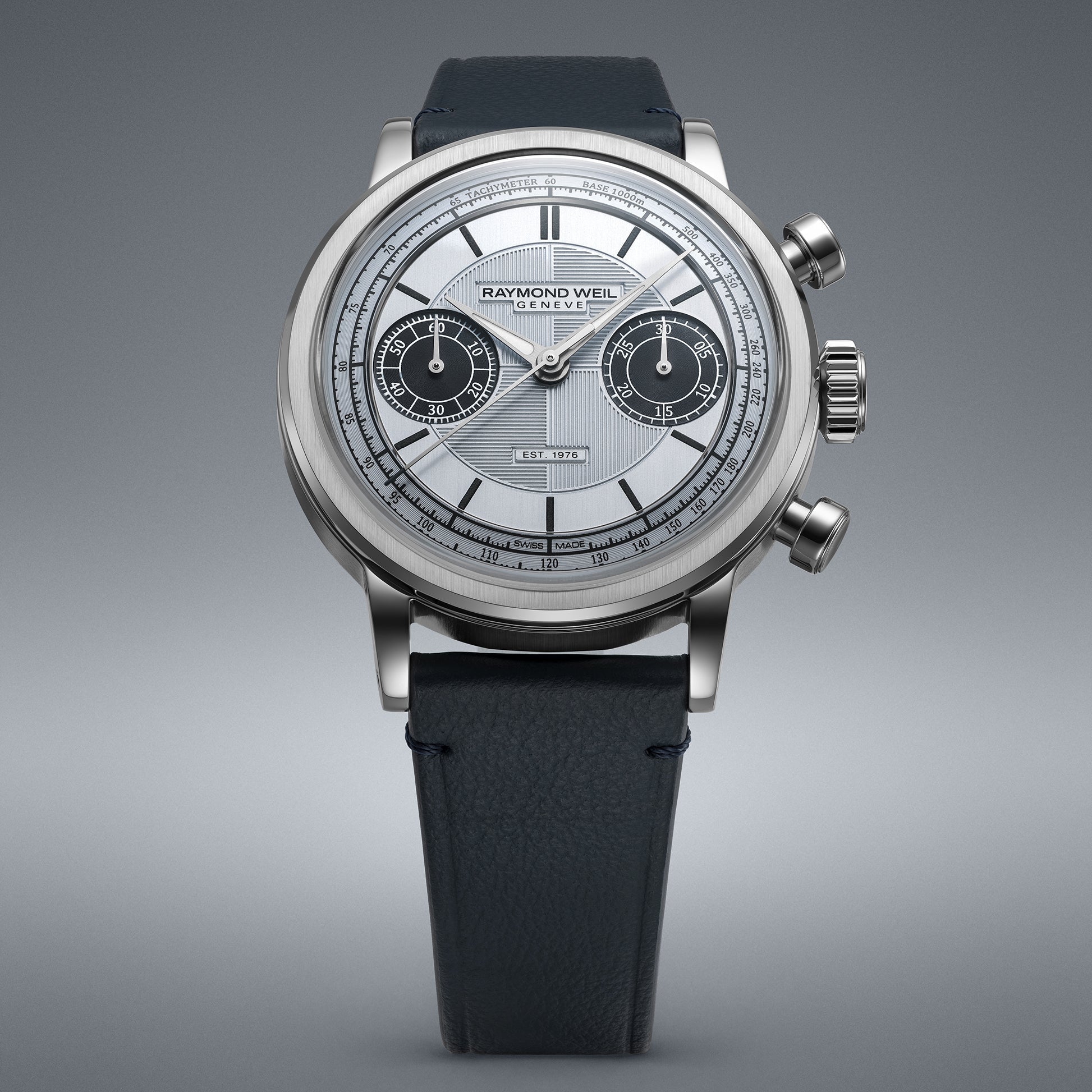
    Raymond Weil’s Millesime Jubilee is a 500 piece bi compax chronograph marking the brand’s 50th anniversary. In Raymond Weil’s announcement, the company traces its origins to Geneva in 1976 and frames the anniversary around three generations of family ownership and independence.

    This isn’t just an anniversary logo exercise. It follows “The Fifty,” introduced earlier this year, offering collectors a more conventional mechanical proposition: a 39 mm stainless steel case, 12.9 mm thickness, and an automatic RW5030 chronograph caliber with a 62 hour power reserve visible through a sapphire caseback.

    The dial is light blue with two midnight blue sub dials, black Super LumiNova indexes with green emission, and obelisk shaped hands under a sapphire glassbox crystal. Water resistance is 50 meters.

    The watch, ref. 7776 STC 65501, is priced at 3,895 CHF for 500 pieces per the product page.

    What collectors will note: a stated caliber, a hard production cap, a published reference, and a price set by the brand. In a year built around Raymond Weil’s independence story, the Jubilee gives that story a tangible, mechanical shape.

    Reference7776-STC-65501
    Price3,895 CHF
    Released2026-09-29
    Case39 mm, stainless steel, 12.9 mm thick
    MovementRW5030, automatic chronograph, 62-hour power reserve
    Water Resistance50 m / 165 ft / 5 atm
    SpecsLight blue dial, two midnight-blue sub-dials, black Super-LumiNova indexes with green emission, obelisk-shaped hands, sapphire glassbox crystal with double-sided anti-reflection coating, snapped caseback with sapphire display window

    Source: raymond-weil.com

    Why this watch, on this wrist?