Author: Gabby

  • Seiko’s 145th Anniversary Prospex Diver HBB001: 9,999 Pieces at $595, on Sale Since June

    Seiko’s 145th Anniversary Prospex Diver HBB001: 9,999 Pieces at $595, on Sale Since June

    LOOK BACK

    Seiko’s 145th Anniversary Prospex Diver HBB001: 9,999 Pieces at $595, on Sale Since June

    The cheaper half of Seiko’s anniversary pair is still the more interesting value story.

    Seiko Prospex HBB001 (Seiko 145th Anniversary Limited Edition)

    Image: Seiko

    Seiko announced the Prospex HBB001 on 14 May 2026 as one of two 145th Anniversary Limited Editions, with availability from June 2026. It is a limited edition of 9,999 pieces at $595, and it remains listed on Seiko’s US site. Its sibling is the HBC005, a 1965 Heritage Diver reissue with the 6R55 movement, 300m rating, 4,000 pieces and a $1,400 price.

    The case is stainless steel at 41.7 mm across and 12.3 mm thick, with a 49.5 mm lug-to-lug and 20 mm lugs, under a Hardlex crystal, on a steel bracelet. Water resistance is 200 meters, which Seiko describes as suitable for scuba diving. Inside is the 4R35, automatic with hand winding, 23 jewels, 21,600 vph, and roughly 41 hours of reserve. Seiko’s own Key Features copy sums up the look as “the angular design enhanced by a sleeker more compact profile.”

    The press release describes a bold, sculpted case with sharp faceting and a two-tone aluminum bezel, silver across the 0 to 15 minute scale and blue for the rest. Worn & Wound identifies the platform as Seiko’s “Samurai” and puts the dial a shade or two darker than the silver on the HBC005.

    The key detail is the price. At 145 years, Seiko’s milestone piece is a sub-$600 Prospex, a contrast to the premium-ceiling watches most brands release for such occasions. With 9,999 pieces, “limited” is doing light work here, and that is the point: this is an anniversary watch built to be bought, not hunted.

    ReferenceHBB001
    Price$595
    EditionLimited edition of 9,999 pieces
    ReleasedAnnounced 14 May 2026, available from June 2026
    Case41.7 mm diameter, 12.3 mm thick, stainless steel, 20 mm lug width, Hardlex crystal
    MovementCaliber 4R35, automatic with manual winding, 21,600 vph, 23 jewels, approx. 41-hour power reserve
    Water Resistance200 m (660 ft), suitable for scuba diving

    Source: seikousa.com, seikowatches.com, wornandwound.com

    And at Spot.Watch — that’s always worth noticing.
  • Ocean Crawler’s Case for Swiss Automatic Longevity, and a Paid Warranty to Match

    Ocean Crawler’s Case for Swiss Automatic Longevity, and a Paid Warranty to Match

    DROP

    Ocean Crawler's Case for Swiss Automatic Longevity, and a Paid Warranty to Match

    The US microbrand's blog post puts the "generations" claim in writing, letting collectors separate engineering from marketing.

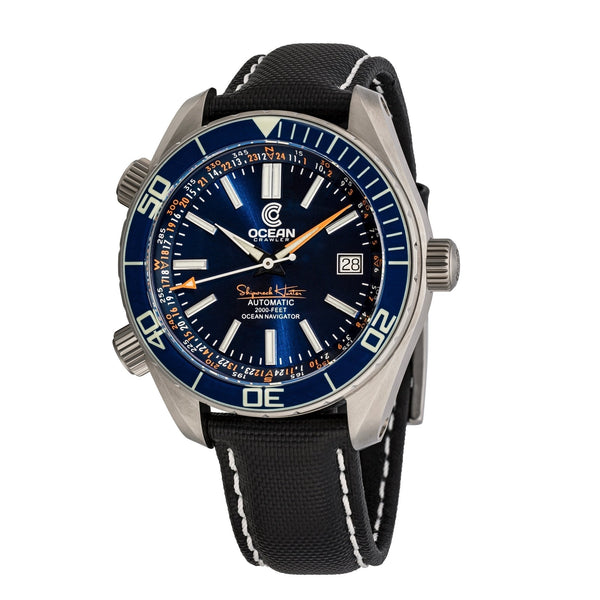
    Ocean Crawler’s September 23, 2026 post, Why Swiss Automatic Watches Are Built to Last for Generations, bylined Christian Champion, is a category explainer, not a product launch. Its value to collectors: the familiar claim that mechanical watches outlive their owners is here in writing, not just industry folklore.

    The post breaks down into three parts.

    The first covers standard horology: rotor, mainspring, gear train, jewels and balance wheel, all described in the abstract. It notes that mainsprings give out after a number of years and that swapping one is routine service work. It describes pivots turning in synthetic ruby jewels to reduce metal-on-metal wear, and a watchmaker regulating the balance as standard corrective work.

    The second part is where the argument stretches. The page attributes “modular construction” to Swiss mechanical movements and describes them as made for easy disassembly, regulation and what it calls infinite repairability. It goes further and says longevity is potentially infinite, provided maintenance continues and replacement parts remain obtainable. Ocean Crawler frames that conditionally, to its credit, and it does put a number on maintenance: the service interval offered by most watch companies, it says, is about five to seven years, with rarely worn watches able to go longer, and accuracy and balance amplitude as the proper test of whether service is due. That is standard industry guidance rather than a promise specific to Ocean Crawler’s own watches, and the page names no jewel count. The modular-construction assertion is not attributed to any movement maker, though the page does name its own workhorse: the Sellita SW200-1, which Champion says is present in many Ocean Crawler watches and was chosen for durability and global parts availability. So the engineering half of the argument is thinner than the language suggests, but it is not empty.

    The third part is commerce. The same page advertises a five-year warranty on all watches and an optional 10-Year Extended Warranty at $199. “A quality mechanical watch will outlast its owner,” Ocean Crawler writes, a few scrolls above a decade of coverage sold as an add-on.

    ReleasedSeptember 23, 2026 (as dated on the blog post itself)
    SpecsSellita SW200-1 named as the movement in many Ocean Crawler watches; service interval cited as five to seven years (industry norm); five-year warranty standard, 10-year extended warranty $199; no model-specific case, jewel-count or water-resistance figures

    Source: oceancrawler.com

    And at Spot.Watch — that’s always worth noticing.

  • Rolex Revisits the Making of the Deepsea Challenge Experimental Watch

    LOOK BACK

    Rolex Revisits the Making of the Deepsea Challenge Experimental Watch

    This is an older upload from Rolex’s own channel, dating back to 2012, documenting how the brand built its Deepsea Challenge, the experimental watch strapped to the manipulator arm of James Cameron’s submersible during his solo dive to the Mariana Trench. It is a worthwhile watch for anyone curious about the engineering behind Rolex’s deepest ever dive test, long before the modern Deepsea Challenge collection existed.

    Why this watch, on this wrist?

  • Seiko’s Presage Classic Series Honors Tomioka Silk in a 2,000-Piece Limited Edition

    Seiko’s Presage Classic Series Honors Tomioka Silk in a 2,000-Piece Limited Edition

    LOOK BACK

    Seiko's Presage Classic Series Honors Tomioka Silk in a 2,000-Piece Limited Edition

    Four watches, a 38.0mm case new to the line, and Caliber 6R51. Announced June 18, 2026 and on sale since July.

    Seiko’s Presage Classic Series additions, announced on June 18, 2026 and in U.S. Seiko luxe retailers since July, draw their dial patterns from Tomioka silk, which Seiko describes as “a premium Japanese silk produced in the region surrounding the Tomioka Silk Mill in Gunma Prefecture.” The mill itself was added to the UNESCO World Heritage list in 2014, and Seiko points to the Tomioka Silk Promotion Organization, set up in 2021, as the body supporting the material and the people who make it.

    One of the four is limited to 2,000 pieces. Seiko describes its dial as “finished with a pearl-like coating that shimmers gracefully in the light and imparts a sophisticated radiance,” and pairs it with a stainless steel case in pink-gold-colored plating and a dark brown leather strap that the release links to the mill’s brick facade. The other three are regular production, in steel with Seiko’s super-hard coating, in three traditional Japanese colors: shironeri, a white; wakatake-iro, a green; and sakura-iro, a pink.

    For a line known for lacquer and enamel, silk offers a distinct tactile reference.

    All four use a 38.0mm case, 12.9mm thick, which Seiko calls a new size for the Classic Series, and Caliber 6R51 with a power reserve of about 72 hours.

    Seiko lists the reference numbers (HCC008 for the limited edition; HCC001, HCC002 and HCC003 for the others) and U.S. prices: $1,150 for the limited edition, $995 for each regular model. Anyone deciding whether to chase the HCC008 has the price, the case, the movement, the size and the number 2,000 to go on, and three months of retail availability to gauge how fast they are moving.

    ReferenceHCC008 (limited edition, 2,000 pieces); HCC001, HCC002, HCC003 (regular production)
    Price$1,150 (HCC008); $995 (HCC001, HCC002, HCC003)
    ReleasedAnnounced June 18, 2026; on sale at select Seiko luxe retailers in the U.S. from July 2026. Specs: 38.0mm stainless steel case, 12.9mm thick (pink-gold-colored plating on HCC008, super-hard coating on the regular models); Caliber 6R51 automatic, about 72 hours power reserve

    Source: seikowatches.com, Monochrome

    And at Spot.Watch — that’s always worth noticing.

  • IWC Marks 50 Years of the Genta Ingenieur With Two Limited Editions in a New Film

    NEW VIDEO

    IWC Marks 50 Years of the Genta Ingenieur With Two Limited Editions in a New Film

    The film names sizes and production limits. IWC's own product pages fill in the rest: IW328910 at $15,000 and IW324909 at $12,900, 1,150 pieces each.

    IWC released “Gérald Genta’s Ingenieur: 50th Anniversary Reworked, Refined, Rethought” on 20 September 2026, five days after the two watches were announced on 15 September. The film calls them “Gérald Genta’s vision, perfected.”

    The narration presents two anniversary watches, 40mm and 35mm, each capped at 1,150 pieces, fifty years on from Genta’s 1976 Ingenieur SL. It describes a brushed silver-plated dial drawn from a rare 1970s variant of Reference 1832, rhodium-plated hands and Super-LumiNova markers. IWC’s release says the lightning bolt beneath the Ingenieur name “has been replaced with the number 50”; hands-on reports from Time+Tide and Oracle of Time describe the bolt still in place with a small 50 sitting at its base.

    The references, prices and specs are on IWC’s site. The Ingenieur Automatic 40 50th Anniversary, IW328910, is 40mm by 10.7mm in steel on an integrated steel bracelet, runs the in-house Calibre 32111 with a 120-hour reserve, and is priced at $15,000. The Ingenieur Automatic 35 50th Anniversary, IW324909, is 35.1mm by 9.4mm, runs Calibre 47110 with a 42-hour reserve, and is priced at $12,900. Both are rated to 10 bar and carry a soft-iron inner case. IWC lists both as current novelties, with no separate delivery date given.

    Source: youtube.com, press.iwc.com, iwc.com (IW328910), iwc.com (IW324909), timeandtidewatches.com, oracleoftime.com

    And at Spot.Watch — that’s always worth noticing.

  • Vero Watch Company: Portland Tool Watches With a Straight Story

    Vero Watch Company: Portland Tool Watches With a Straight Story

    MICROBRAND

    Vero Watch Company: Portland Tool Watches With a Straight Story

    An Oregon brand named for the truth, backed by a 10-year warranty and a bear that has raised real money for wildfire prevention.

    Vero Smokey Bear Blue Skies Edition field watch

    The Smokey Bear Blue Skies Edition. Image: Vero Watch Company

    Origin

    Chris Boudreaux founded Vero Watch Company in Portland, Oregon, in 2015 with a friend, according to Mainspring’s profile of the brand. He came to watches from the outdoors side. He competed in marathons and multiple Ironman races and ran a sporting goods store selling everyday-carry gear. His collection began with a Breitling for Bentley 6.75, bought to mark his marriage, and moved on through Panerai, Bell & Ross and Tudor.

    Vero is Latin for truth. The founders chose it as a mantra, a daily reminder to be straight with themselves and with their customers. That is a bold name for a watch brand, because provenance is exactly where small brands tend to get vague.

    What Makes It Notable

    Vero’s early pitch was unusually specific: most parts made in the United States, watches assembled in Portland. Worn & Wound covered the process in its “How Watches Are Made” feature on the brand.

    That changed in 2021. Mainspring reports that Vero shifted production to Switzerland to hold quality while lowering retail prices and raising capacity. The brand says it still assembles, services and warranties its watches in its Portland shop. The honest version of the story includes both halves. It is a trade many American microbrands have made, and it means Vero’s case now rests less on origin than on what happens after you buy.

    What happens after you buy is a 10-year warranty. Mainspring describes it as no questions asked, covering repairs regardless of how the damage happened. That is far beyond what most small brands offer, and it is the clearest expression of the name: a company confident enough in its tool watches to keep fixing them for a decade.

    The brand’s other signature is conservation. Vero’s Smokey Bear watches are officially licensed with Smokey Bear and the U.S. Forest Service, and the company gives 10 percent of proceeds from them to wildfire prevention. By its own count, that has passed $100,000.

    Signature

    Vero builds field and adventure watches meant to be worn hard: legible dials, practical proportions and cases that suit hiking, travel and daily wear without tactical theater. The Smokey Bear line is the most visible today, with the Blue Skies and Campfire editions, the Smokey ’44 and ’64, and an 80th anniversary pair in Brilliant Blue and Forest Green, priced from $525 to $595 on Vero’s site.

    The Open Water series brings the same approach to diving, with references such as North Coast and Crown Point, and the Workhorse line includes a chronograph. It was not always this accessible. Vero’s first model, the VS, sold for close to $3,000. Swiss production is a large part of how the brand reached its current price point.

    Why Spot.Watch Thinks It Matters

    Vero does not claim to reinvent the field watch. It tries to make a familiar category more trustworthy: a name that means truth, a decade of warranty, Portland hands on every service, and a production story that holds up once you know both halves of it. Those are not glamorous talking points, but they are useful ones. In a microbrand market full of borrowed nostalgia and fuzzy backstories, that still counts for something.

    Visit Vero Watch Company →

    Sources: Mainspring, vero-watch.com, Worn & Wound

    Why this watch, on this wrist?

  • Serica Revisits the 5303 Dive Watch in Old Channel Upload

    LOOK BACK

    Serica Revisits the 5303 Dive Watch in Old Channel Upload

    This is a throwback upload from Serica’s own channel, first posted back in April 2021 to spotlight the 5303. The video walks through the watch’s 39mm case, refined proportions, tapering bracelet and high level automatic caliber, making the case for it as a dive watch equally suited to daily wear on land. Worth a look for anyone tracking how Serica’s design language has held up years later.

    Why this watch, on this wrist?

  • Henry Archer Looks Back at the Minimalist Relativ Watch

    LOOK BACK

    Henry Archer Looks Back at the Minimalist Relativ Watch

    This is an older upload from Henry Archer’s own YouTube channel, dated back to May 2021, spotlighting the Relativ. The brand describes it as its take on marrying function, design and minimalism, built with a sapphire crystal and luminous indices. Worth a watch for a quick look at how the microbrand approached clean, pared back design early on.

    Why this watch, on this wrist?

  • Christopher Ward Expands the C63 Sealander with a Sellita SW510 Chronograph in Five Dials

    Christopher Ward Expands the C63 Sealander with a Sellita SW510 Chronograph in Five Dials

    DROP

    Christopher Ward Expands the C63 Sealander with a Sellita SW510 Chronograph in Five Dials

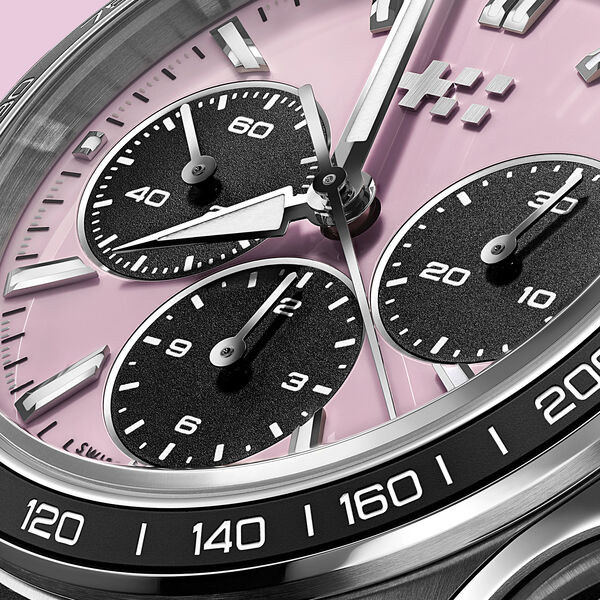
    Christopher Ward describes the C63 Sealander Chronograph as "the brand's first mechanical chrono in years." Six of them, by the press's count: the last one arrived in 2020. All five dials cost $2,625 on rubber or $2,765 on the Bader bracelet.

    The Sealander has been Christopher Ward’s everyday-sport workhorse for years, and it now carries a mechanical chronograph. Christopher Ward’s product page lists the C63 Sealander Chronograph in five dial colours: Black, White, Pistachio, Sky Blue and Pink. Five dials at once suggest a full collection, not a cautious debut.

    The movement is named outright, which is more than some brands manage. It is the Sellita SW510 automatic chronograph, 27 jewels, running at 28,800vph, in a three-subdial 3-6-9 layout under a sandblasted ceramic bezel with a tachymeter scale. Water resistance is 100m.

    The product page gives conflicting power-reserve figures: the descriptive copy cites “at least 56 hours (more typically 62),” while the technical table lists a flat 62 hours. Read the lower number if you want the conservative figure.

    The selling point is the height. At 13.9mm the case is described as “our slimmest yet” and 1.1mm thinner than the brand’s previous chronographs. The 41mm steel case measures 48mm lug to lug, a wearable footprint for a tricompax.

    Pricing is the same across all five dials: $2,625 (£1,895) on one of the four integrated rubber straps, $2,765 (£1,995) on the iLink Bader bracelet, per Time+Tide and Oracle of Time. The watch launched on September 17, 2026. Black and White dials shipped immediately, per Gear Patrol, while Pistachio, Sky Blue and Pink are on pre-order for mid-October 2026 delivery. Gear Patrol also dates the brand’s last mechanical chronograph to 2020, which makes this the first in six years.

    ReferenceC63-41ACH4-S0KK0-B0 (Black dial, Bader bracelet); five dial colourways
    Price$2,625 / £1,895 on rubber strap; $2,765 / £1,995 on Bader bracelet; same for all five dials
    ReleasedSeptember 17, 2026; Black and White dials available at launch, Pistachio, Sky Blue and Pink on pre-order for mid-October 2026 delivery
    Specs41mm stainless steel case, 13.9mm height, 48mm lug-to-lug, 84g case weight (174g with strap); Sellita SW510 automatic chronograph, 28,800vph, 27 jewels, power reserve given as "at least 56 hours (more typically 62)" in the product copy and a flat 62 hours in the technical table; water resistance 10 ATM / 100m; sandblasted ceramic bezel with tachymeter scale; three-subdial (3-6-9) chronograph layout; iLink™ Bader bracelet with quick-release plus four integrated rubber strap colors (Black, White, Blue, Orange); five dial colorways

    Source: christopherward.com, Gear Patrol, Time+Tide, Oracle of Time

    And at Spot.Watch — that’s always worth noticing.

  • Oris Hölstein Edition 2025: the CHF 4,150 Black DLC ProPilot Limited to 250, a Year On

    Oris Hölstein Edition 2025: the CHF 4,150 Black DLC ProPilot Limited to 250, a Year On

    LOOK BACK

    Oris Hölstein Edition 2025: the CHF 4,150 Black DLC ProPilot Limited to 250, a Year On

    Launched June 2, 2025 with a bear hidden in the lume, the ProPilot edition has already been followed by a 2026 Artelier. The numbers were published at the time.

    Oris Hölstein Edition 2025 (a ProPilot-based watch)

    Image: Oris

    Oris released the Hölstein Edition 2025 on June 2, 2025, one in its annual series celebrating the brand’s home village. Oris’s announcement links the watch to the brand’s 1904 founding in Hölstein, Switzerland, and to its habit of releasing a Hölstein Edition every June 1.

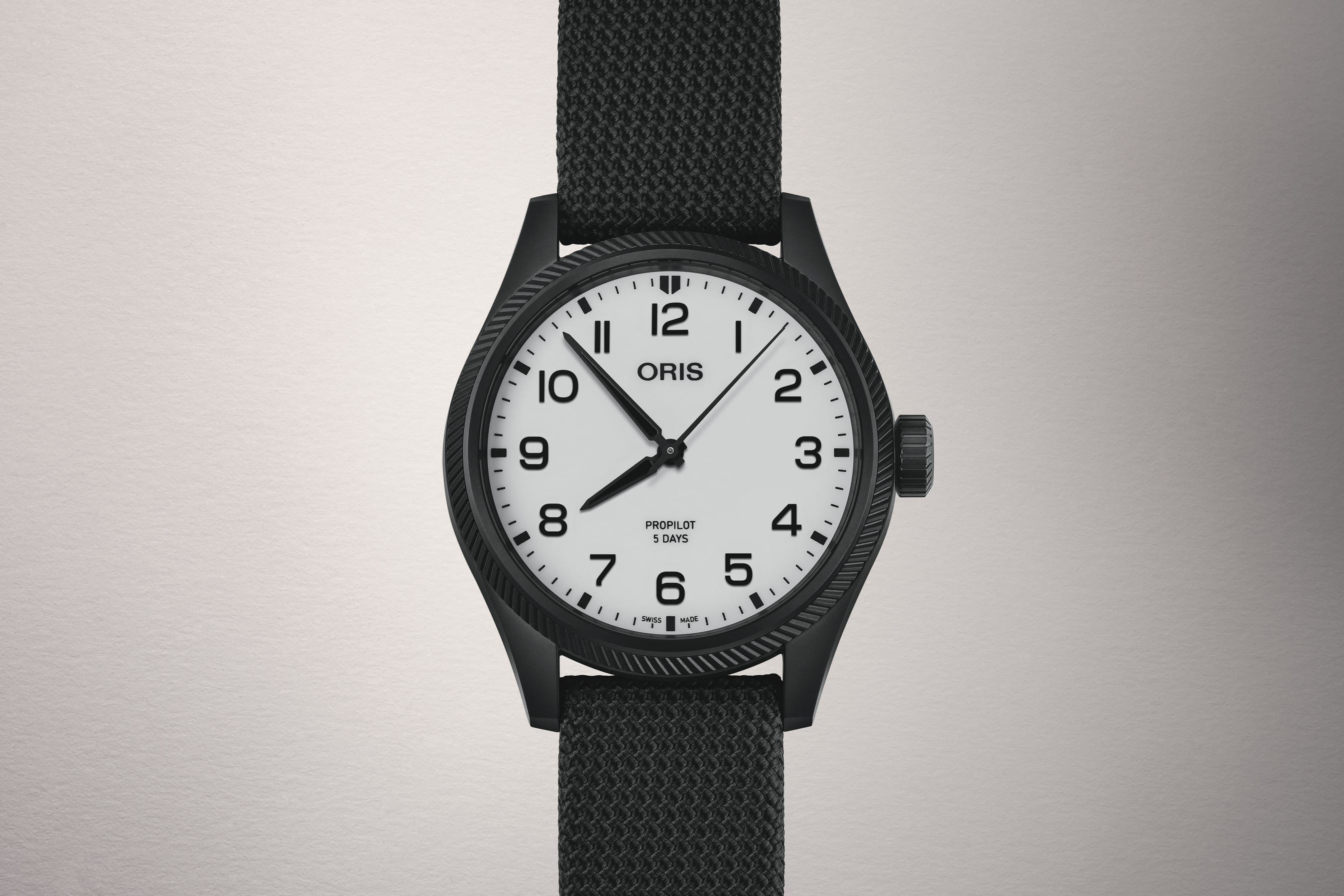
    The 2025 edition is based on the ProPilot, with a black DLC-coated case and a fully lumed dial. In the dark, the lume glows green to reveal the Oris Bear. It houses the in-house Calibre 400. Only 250 pieces were made, each individually numbered.

    The specification was published at launch. Reference 01 400 7803 4781-Set: a 41mm steel case in black DLC, 11.9mm thick, 100m water resistance, Calibre 400 with its 120-hour power reserve and 10-year warranty, on a black textile strap with a DLC folding clasp. The price was CHF 4,150 (USD 5,000 on Oris’s US site), per Monochrome and Oris’s product page, which now lists the watch as out of stock.

    Its successor arrived on June 1, 2026. The Hölstein Edition 2026 is an Artelier with the small-seconds Calibre 401, reference 01 401 7812 4081-Set, again 250 pieces, at CHF 3,800, per Monochrome.

    Reference01 400 7803 4781-Set
    PriceCHF 4,150 (USD 5,000)
    ReleasedJune 2, 2025, limited to 250 pieces

    Source: oris.ch, oris.ch (product page), monochrome-watches.com (2025), monochrome-watches.com (2026)

    And at Spot.Watch — that’s always worth noticing.