Author: Gabby

  • Henry Archer’s Vesterhav Video Is an Owner’s Manual, Not a Movement Tour

    NEW VIDEO

    Henry Archer's Vesterhav Video Is an Owner's Manual, Not a Movement Tour

    The Danish microbrand's 'Understanding the watch' film spends its two and a half minutes on crown positions and bracelet links.

    Henry Archer posted a short guide to the Vesterhav on its channel September 10, 2026. The chapter list leaves no mystery: the hands, the crown’s positions, winding, reading a.m. from p.m., setting time and date, screwing the crown back down, the on-the-fly micro-adjust, and adding or removing a bracelet link.

    That’s useful, and rarer than it should be from a small maker. It’s also not the technical deep dive the title implies. Case construction and finishing go untouched.

    The description calls it a guide to the Vesterhav and its Miyota 9015. That’s the only movement detail here; nothing else confirms it. Power reserve, water resistance, lug width and price are all left unsaid.

    Source: youtube.com

    Why this watch, on this wrist?

  • King Seiko VANAC HKF005: a Tokyo City-Lights Dial in 41 mm Steel, 8L45 Inside, €3,400, October Release

    King Seiko VANAC HKF005: a Tokyo City-Lights Dial in 41 mm Steel, 8L45 Inside, €3,400, October Release

    LOOK BACK

    King Seiko VANAC HKF005: a Tokyo City-Lights Dial in 41 mm Steel, 8L45 Inside, €3,400, October Release

    Announced September 9, 2026, the eighth VANAC reference is the first with a glitter-flecked night dial. The specs are on Seiko's own product page; the price comes from the European press.

    Seiko updated its King Seiko VANAC page on September 9, 2026. The lineup now includes eight references. Seven were already familiar to collectors: SLA083, SLA085, and SLA087 in purple, navy, and silver; the boutique-exclusive ice-blue SLA091; the gold-dialed limited SLA089; and the leather-strapped SLA093 and SLA095. The newcomer, HKF005, carries a dial that Seiko says “evokes the countless city lights shimmering across Tokyo at night.” The “Tokyo by Night” tag is Monochrome’s headline, not Seiko’s.

    This is a genuine addition to the 1972 VANAC revival, and Seiko’s HKF005J1 product page carries the full sheet.

    What Seiko confirms: all eight references use the 8L45 caliber, which the brand states “achieves a power reserve of 72 hours” and is rated to +10/-5 seconds per day. The HKF005 case is stainless steel, 41.0 mm across, 14.3 mm thick and 45.1 mm lug to lug, with a box-shaped sapphire crystal, screw-down crown, see-through caseback, 10 bar water resistance and a 17 mm interchangeable band. Seiko lists the release as October 2026 and does not flag it as a limited edition.

    What Seiko’s US page leaves off is the price. Monochrome puts it at €3,400, in line with the steel SLA083, which Seiko lists at USD 3,300. The dial is not aventurine: it is Seiko’s own glitter-particle finish on a ground that Monochrome describes as somewhere between black and a very dark grey-blue.

    For collectors tracking the VANAC revival reference by reference, the practical takeaway is simple. HKF005 is an 8L45 watch in the same 41 mm steel case as the SLA trio, priced alongside them, with the first dark dial in the series and an October 2026 release.

    ReferenceHKF005 (HKF005J1, Tokyo city-lights dial); SLA083, SLA085, SLA087; SLA089; SLA091; SLA093, SLA095
    PriceHKF005: €3,400, per Monochrome; SLA083: USD 3,300, per Seiko
    ReleasedHKF005: announced September 9, 2026, on sale October 2026; SLA083, SLA085, SLA087, SLA089, SLA091: July 2025; SLA093, SLA095: January 2026
    SpecsCaliber 8L45; 72-hour power reserve; +10/-5 seconds per day; stainless steel, 41.0 mm x 14.3 mm, 45.1 mm lug to lug; box sapphire crystal; 10 bar; 17 mm interchangeable band; not limited

    Source: seikowatches.com, seikowatches.com (HKF005J1), seikowatches.com (SLA083J1), monochrome-watches.com

    And at Spot.Watch — that’s always worth noticing.

  • The Watchmakers of Austria

    The Watchmakers of Austria

    WATCHES BY THE COUNTRY

    The Watchmakers of Austria

    From the gilded clocks of the Habsburg court to hand-finished chronographs made in the shadow of the Alps.

    Austria’s horological story begins in the imperial imagination. During the long reign of the House of Habsburg, Vienna was one of Europe’s great capitals of culture and craft, and its finest workshops kept time for emperors, empresses, and the intellectual class that gathered in the city’s coffee houses. The name that best captures this era is Carl Suchy, whose family firm rose from a Prague workshop, founded in 1822, to become “Purveyor to the Imperial and Royal Court,” as chronicled by Collective Horology. Emperors from Ferdinand I to Franz Joseph I, and clients as varied as Sigmund Freud, are counted among the brand’s historical patrons.

    After the empire fell and the 20th century swept its old certainties away, Austrian watchmaking went quiet for decades. What has emerged in recent years is smaller but no less serious: a compact scene split between technically rigorous independents, revived heritage names, and design-driven microbrands that mine Austrian history, civic culture, and Alpine landscapes for inspiration. The output today runs the full spectrum, from accessible everyday watches to hand-finished, in-house complications.

    The Makers

    Serious independents

    Habring² is the technical heart of Austrian watchmaking. Founded in 2004 by Maria and Richard Habring and based in Völkermarkt, Carinthia, the workshop builds genuinely Austrian-made mechanical watches, including complications that would flatter far larger houses. Its split-seconds chronographs and deadbeat (jumping) seconds movements have earned it a devoted following among collectors who value substance over spectacle. For a country with a small industry, Habring² punches enormously above its weight, and among the names on this list it is the only one whose movements are made in Austria.

    Revived heritage

    Carl Suchy & Söhne carries the weight of the deepest name in Central European watchmaking. Tracing its lineage to 1822 and the imperial court connections detailed above, the modern brand was revived in 2016 by art and design entrepreneur Robert Punkenhofer as an Austrian luxury label; its contemporary watches are designed in Vienna but run on Swiss-made movements, per Collective Horology. Rather than trading purely on nostalgia, the watches lean into Viennese design culture, drawing a line from the city’s artistic heritage to the wrist. It is the rare case of a historic name whose story is worth the revival.

    Carl Suchy & Söhne Waltz N°1 Blue Danube, steel case with blue guilloché dial and small seconds, on a navy leather strap

    Carl Suchy & Söhne Waltz N°1 Blue Danube. Image: Carl Suchy & Söhne

    Everyday and functional

    Jacques Lemans is Austria’s most widely distributed watch company, headquartered in St. Veit an der Glan, Carinthia, and founded in 1974. Its range spans fashion, sport, quartz, and mechanical pieces across several lines, making it many buyers’ first Austrian watch and a familiar sight in shop windows well beyond the country’s borders. If Habring² and Carl Suchy represent the high end, Jacques Lemans anchors the accessible one.

    LAKS takes Austrian watchmaking in a distinctly modern direction. Best known for wristwatches and wearable payment technology, including its LAKS Pay and Watch2Pay concepts, the company is more interested in function and connectivity than in traditional haute horlogerie. It is a reminder that a national watch scene can innovate at the intersection of timekeeping and everyday utility, not only at the workbench.

    Normalzeit is perhaps the most quintessentially Viennese entry on this list. The label draws its name and its look from Vienna’s public standard-time clocks, the civic timepieces once dotted around the city, and translates that recognizable visual language into minimalist wristwatches. For anyone who loves the idea of wearing a piece of a city’s design history, Normalzeit offers exactly that.

    The Close

    Austria will never rival Switzerland in volume, and it does not try to. What it offers instead is a small, characterful family of makers who each speak in a different Austrian accent: the technical seriousness of Habring², the courtly heritage of Carl Suchy & Söhne, the broad reach of Jacques Lemans, the forward-looking utility of LAKS, and the civic minimalism of Normalzeit. Together they suggest a horological identity that is quietly re-forming, one watch at a time, along the same Danube that flows past Vienna, the imperial capital that Suchy’s Prague workshop once served.

    Spot.Watch will keep watching the Alpine scene. Until next country, keep your eyes on the wrist.

    Source: Collective Horology, jacques-lemans.com, carlsuchy.com (press kit)

    And at Spot.Watch — that’s always worth noticing.

  • Two Limited ATTESA Watches Celebrate 50 Years of Citizen Eco-Drive

    Two Limited ATTESA Watches Celebrate 50 Years of Citizen Eco-Drive

    DROP

    Two Limited ATTESA Watches Celebrate 50 Years of Citizen Eco-Drive

    Two 1,500-piece ATTESA watches capture rare natural phenomena: the green flash and the aurora.

    Citizen ATTESA Eco-Drive 50th Anniversary Edition, Power of Green Flash and Power of Purple Aurora (two limited-edition models)

    Image: Citizen

    Citizen has announced two limited-edition ATTESA watches to celebrate 50 years of Eco-Drive: the CC4084-83Z (Power of Green Flash) and the CC4085-81Z (Power of Purple Aurora). Each is limited to 1,500 pieces worldwide and will debut in October 2026, according to Citizen’s newsroom.

    Citizen traces Eco-Drive’s origins to 1976, calling that first model the world’s first light-powered analog watch.

    Both use the Cal. F950 Eco-Drive Satellite Wave GPS movement, which Citizen rates at ±5 seconds per month without signal reception. GPS sync takes as little as three seconds. There is a perpetual calendar, a 1/20-second chronograph running to 24 hours, world time, and a five-year run in power-save mode from a full charge.

    Cases and bracelets are Super Titanium: Duratect DLC with Duratect Amber Yellow on the Green Flash, Duratect DLC with Duratect Pink on the Aurora. Citizen publishes no titanium grade beyond the trademark. It lists 44.6mm by 15.4mm for CC4084-83Z and labels that figure “design specification only.”

    The dial work is where this earns attention, because Citizen names its methods: structural colour film, inkjet-printed black layers, vapour deposition. Of the aurora, Citizen writes that “the breathtaking purple colour can be seen in the night sky in polar regions when particles from the Sun collide with the Earth’s atmosphere.”

    Projected global pricing is USD 2,515 for both.

    ReferenceCC4084-83Z (Power of Green Flash); CC4085-81Z (Power of Purple Aurora)
    PriceUSD 2,515 (projected), for both references.
    ReleasedAnnounced 9 September 2026; launch "October 2026 (Scheduled)" per Citizen Global.
    Specs– Movement: Cal. F950, Eco-Drive Satellite Wave GPS. Accuracy ±5 seconds/month without time-signal reception; GPS signal reception in as little as 3 seconds ("world-class speed" per Citizen); Eco-Drive runs 5 years on full charge in power-save mode; World Time function; 1/20-second chronograph measuring up to 24 hours; Light Level Indicator; Power Reserve Indicator; Perpetual Calendar; Double Direct Flight function for switching local/overseas time. Stated for both models.

    Source: citizenwatch-global.com

    And at Spot.Watch — that’s always worth noticing.

  • Vacheron Constantin’s Twin Beat: A Perpetual Calendar With Two Balances

    LOOK BACK

    Vacheron Constantin’s Twin Beat: A Perpetual Calendar With Two Balances

    This 2019 throwback from Vacheron Constantin’s own channel revisits the Traditionnelle Twin Beat Perpetual Calendar, a watch built around dual balance wheels letting the wearer switch between active and standby modes to save power without disturbing the calendar. It’s a deep dive into one of the brand’s more ambitious mechanical solutions.

    Why this watch, on this wrist?

  • Vacheron Constantin Films the Papercroc, a 42 mm Pink Gold Métiers d’Art Piece With a Crocodile Dial Cut From Cotton Paper

    NEW VIDEO

    Vacheron Constantin Films the Papercroc, a 42 mm Pink Gold Métiers d'Art Piece With a Crocodile Dial Cut From Cotton Paper

    The film is all craft, but the watch behind it has a reference, a calibre and a named paper artist: Marianne Guély.

    Vacheron Constantin has posted a short film on its own channel about Papercroc, one of the six Métiers d’Art Tribute to the Animal Kingdom concept pieces the Maison unveiled on August 28, 2026. The dial depicts a white crocodile in snow-laden reeds, sculpted from cotton paper instead of enamel or engraving. The paper work is by Paris studio artist Marianne Guély, credited on the Homo Faber listing for the piece.

    The Maison notes brass matrices cut specifically for the piece, a relief of roughly three millimetres, and what it calls “months of experimentation.” Per Revolution, the crocodile is embossed from 300 gsm acid-free cotton paper, the foliage from 250 gsm, with the heated matrices pressed at 60 to 70 degrees so the sheet neither tears nor warps.

    The film skips the spec sheet, but the launch coverage did not. Papercroc is reference 7630A/000R-H202: a 42 mm by 12.9 mm case in 18k 5N pink gold, 30 m water resistance, and the in-house Calibre 2460 G4 with four disc displays and a 40-hour reserve, per Monochrome. It is presented as a one-off concept watch, boutique-only, price on request, per SJX. Hence the hashtag OneOfNotMany. Watch the film for the craft; the numbers are above.

    Source: youtube.com, monochrome-watches.com, watchesbysjx.com, revolutionwatch.com, homofaber.com

    And at Spot.Watch — that’s always worth noticing.

  • Christopher Ward Launches the Trident Biscay GMT in 39mm and 42mm

    Christopher Ward Launches the Trident Biscay GMT in 39mm and 42mm

    DROP

    Christopher Ward Launches the Trident Biscay GMT in 39mm and 42mm

    A COSC-rated Sellita SW330-2 caller GMT inside a 200m dive case, offered in two sizes and two colourways, from $1,995 on strap, with pre-orders open for delivery at the end of October 2026.

    Christopher Ward launched the Trident Biscay collection on September 1, and the GMT arrived with it, alongside the Biscay Automatic and the 39mm Biscay Bronze. The Trident Biscay GMT comes in 39mm and 42mm cases, both 12mm thick and both powered by the same movement.

    The movement is a COSC-certified Sellita SW330-2, beating at 4Hz with a 56-hour power reserve. The brand calls it a caller GMT, an accurate term. The 24-hour GMT hand is independently adjustable for tracking a second time zone.

    The value proposition is notable: a COSC-certified chronometer, a 200m dive case with a 120-click bidirectional bezel in two aluminium tones, surface-hardened to 250HV, and two case sizes, all on the new Biscay platform that Christopher Ward introduced across three models on the same day.

    The dial features applied numerals in gilt frames, a textured surface, and a date window at 6 o’clock. Lume is Super-LumiNova Grade X1 BL, as the brand specifies it. An exhibition caseback shows Colimaçoné finishing and a redesigned rotor. Bracelets use the brand’s iLink tool-free sizing, with Consort and Bader bracelets and hybrid rubber straps in blue, khaki, black, and tan also listed.

    Two bezel colourways are offered, Black/Red and Sand/Blue, in both sizes. Missing from the specs: clasp or springbar detail and a reference number for the 42mm.

    Pricing starts at $1,995 on a hybrid rubber strap. The configuration shown, reference C60-39AGM1-S0RK0-B1 in 39mm on the Consort bracelet, is $2,275 on pre-order; the Bader bracelet sits between the two at roughly $2,220, per Oracle of Time.

    ReferenceC60-39AGM1-S0RK0-B1 (39mm, Black/Red, Consort bracelet)
    PriceFrom $1,995 on strap; $2,275 on Consort bracelet
    ReleasedAnnounced September 1, 2026; CW page lists this configuration as “Pre-order for End October 2026”

    Source: christopherward.com, Worn & Wound, Oracle of Time

    And at Spot.Watch — that’s always worth noticing.

  • Raymond Weil Revives a 1977 Toccata for Women in Nine 28 mm References

    Raymond Weil Revives a 1977 Toccata for Women in Nine 28 mm References

    LOOK BACK

    Raymond Weil Revives a 1977 Toccata for Women in Nine 28 mm References

    Launched on 4 September for the brand’s 50th year, the quartz Toccata Heritage runs from steel on leather to gold PVD with diamonds, topping out at $2,550.

    Raymond Weil Toccata Heritage 28 mm ref. 5250-PS-00650, yellow gold PVD case and bracelet with diamond-set bezel and white Roman-numeral dial

    Image: Raymond Weil. Shown: yellow gold PVD diamond model, ref. 5250-PS-00650.

    Raymond Weil added a Heritage version to its Toccata women’s line on 4 September 2026, announced in a blog post titled The Toccata Heritage Story Continues. The release sits inside the brand’s 50th-anniversary year and revives what it calls one of its most iconic 1977 designs.

    The 1977 date carries the weight of the story. Raymond Weil was founded in 1976, so a 1977 design sits almost at the company’s origin, which makes it a neat anchor for an anniversary year. The brand offers no archival images or period reference numbers alongside the claim, saying only that “the original proportions have been faithfully preserved.” WatchTime’s German edition, which covered the launch on 6 September, likewise describes the basic form as following the 1977 original.

    The collection includes nine references, all 28 mm and Swiss Made quartz, in stainless steel, rose gold PVD or yellow gold PVD, on a lizard-effect calfskin strap or an integrated steel bracelet with folding clasp; some versions carry a diamond-set bezel. The steel diamond model on bracelet, ref. 5250-STS-00650, is USD 2,425: white dial, Roman numerals, polished blue obelisk hands under anti-reflective sapphire, and 48 lab-grown brilliant-cut diamonds totalling 0.408 carats. The yellow gold PVD version pictured above, ref. 5250-PS-00650, is USD 2,550. Water resistance is 30 m (4 atm) across the line. In Germany the range runs from EUR 1,275 to EUR 2,550, per WatchTime.

    What Raymond Weil does not say is which quartz calibre sits inside, or its battery life; the product pages describe the movement only as Swiss Made quartz, hours and minutes.

    For a watch sold on its archive, the prices and specs are all on the table. The 1977 reference itself is the one thing still taken on trust.

    Reference5250-STS-00650 (steel, diamonds, bracelet); 5250-PS-00650 (yellow gold PVD, diamonds, bracelet); nine references in all
    PriceUSD 2,425 (5250-STS-00650) / USD 2,550 (5250-PS-00650), per raymond-weil.com; EUR 1,275 to 2,550 across the range, per WatchTime
    Released4 September 2026, as dated on the raymond-weil.com blog post
    Specs28 mm case, stainless steel or rose/yellow gold PVD; Swiss Made quartz, hours and minutes; white dial with Roman numerals; anti-reflective sapphire; 30 m (4 atm) water resistance; lizard-effect calfskin strap or steel bracelet with folding clasp; optional 48 lab-grown diamonds, 0.408 ct

    Source: raymond-weil.com, raymond-weil.com (5250-STS-00650), raymond-weil.com (5250-PS-00650), watchtime.net

    And at Spot.Watch — that’s always worth noticing.

  • Seiko Brings the 1913 Laurel Into Regular Presage Production With Enamel and Urushi Dials

    Seiko Brings the 1913 Laurel Into Regular Presage Production With Enamel and Urushi Dials

    LOOK BACK

    Seiko Brings the 1913 Laurel Into Regular Presage Production With Enamel and Urushi Dials

    The HCC005 and HCC006, announced on 13 August and in shops from September, put Japan’s first wristwatch into the standing catalogue at $1,400 and $1,650.

    Seiko announced two new Presage Classic Series models on 13 August 2026: the HCC005 with an enamel dial and the HCC006 with a black urushi lacquer dial. Both draw from the 1913 Laurel, and according to Seiko, this is the first time the Laurel’s Arabic numerals and enamel dial have appeared together outside a limited edition. Both are regular production, not limited runs, and Seiko schedules them for September 2026 release.

    That detail is the real news. Seiko’s designers, quoted on the same page, describe the Laurel as representing “the origins of wristwatch design” for the company, and say they made it the basis of regular-series models rather than limited ones so that more people could experience the design. Permanent availability means no ballots, no allocations, no countdowns.

    The Laurel itself was a bold improvisation. Seiko dates its completion to 1913 and calls it Japan’s first domestically manufactured wristwatch. The movement inside was a 12-ligne calibre, around 27 mm, of a size then intended for pocket watches, fitted into a case of roughly 30 mm. Daily production peaked at 30 to 50 pieces. Seiko also traces two firsts to that era: a domestically made hairspring in 1910, and the fabrication of the Laurel’s own enamel dial face in 1913. HCC005 brings back the red “12” from one of the two original Laurel dial variants.

    The two watches share one spec sheet. Each runs the automatic Cal. 6R5H with roughly 72 hours of reserve in a 39.6 mm steel case, 12.4 mm thick, rated to 3 atm; the HCC005 gets Seiko’s super-hard coating and the HCC006 a yellow gold-coloured plating, per Monochrome. Seiko’s US pages list $1,400 for the HCC005 and $1,650 for the HCC006; European pricing is EUR 1,430 and EUR 1,640, per Monochrome and SJX.

    ReferenceHCC005 (enamel) / HCC006 (urushi lacquer)
    PriceUSD 1,400 (HCC005) / USD 1,650 (HCC006), per Seiko US; EUR 1,430 / EUR 1,640, per Monochrome
    ReleasedAnnounced 13 August 2026; scheduled for September 2026 release as regular production
    SpecsBoth: automatic Cal. 6R5H, 24 jewels, 21,600 vph, approx. 72-hour power reserve; stainless steel case (super-hard coating on HCC005, gold-coloured plating on HCC006), 39.6 mm diameter, 12.4 mm thick, 46.8 mm lug-to-lug, dual-curved sapphire crystal; 3 atm water resistance; leather strap with three-fold clasp

    Source: seikowatches.com, monochrome-watches.com, watchesbysjx.com

    And at Spot.Watch — that’s always worth noticing.

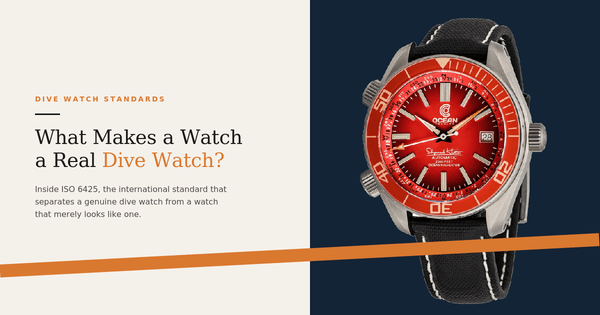
  • Ocean Crawler Breaks Down ISO 6425: What “Compliant” Really Means

    Ocean Crawler Breaks Down ISO 6425: What “Compliant” Really Means

    DROP

    Ocean Crawler Breaks Down ISO 6425: What "Compliant" Really Means

    A US microbrand clarifies the ISO 6425 standard and the marketing terms that follow it.

    Ocean Crawler, the US microbrand, published an explainer on ISO 6425 to its blog on September 1, 2026. The post isn’t tied to a product launch. It’s a rare instance of a brand unpacking a standard that’s routinely name-dropped in dive-watch marketing.

    The post wades into a familiar debate: does a depth rating alone qualify a watch as a true dive watch? Ocean Crawler’s answer is no. The standard, it notes, doesn’t consider a bezel sufficient on its own either.

    According to Ocean Crawler, ISO 6425 requires a watch rated for at least 100 metres, with a secure elapsed-time indicator readable in the dark. The brand cites the current edition as ISO 6425:2018, which ISO reviewed and reaffirmed in 2024. It also describes the standard as pulling in magnetic resistance through ISO 764 and shock resistance through ISO 1413, and as setting legibility of essential indications at 25 centimetres in darkness, with a 50-lux threshold for lit conditions.

    Those figures come from Ocean Crawler’s characterisation of the standard. We have not read them against the ISO document itself, and we are not going to pretend otherwise.

    The most useful passage concerns language. ISO does not certify products, Ocean Crawler notes; independent conformity assessment bodies do that work. Which leads to the line worth carrying around: “That is why ‘ISO 6425 compliant,’ ‘tested to ISO 6425,’ and ‘ISO 6425 certified’ should not automatically be treated as interchangeable claims.”

    Ocean Crawler sells dive watches, so it benefits from buyers who know the difference. It is still an unusually candid thing for a maker to publish, and a handy lens for the next dial you read.

    ReleasedSeptember 1, 2026 (dateline on Ocean Crawler's blog post)
    SpecsNot applicable, no specific watch, case size, material, movement, or water-resistance figure for a product is given in this article; it discusses the ISO 6425:2018 standard in general terms.

    Source: oceancrawler.com

    Why this watch, on this wrist?